The 2025 CEO survey from Inc. 5000 makes one thing clear: AI adoption in 2026 is no longer a future initiative for high-growth tech companies; it is a current priority. Nearly every tech CEO surveyed expressed confidence in AI and plans to use it inside their organization this year.
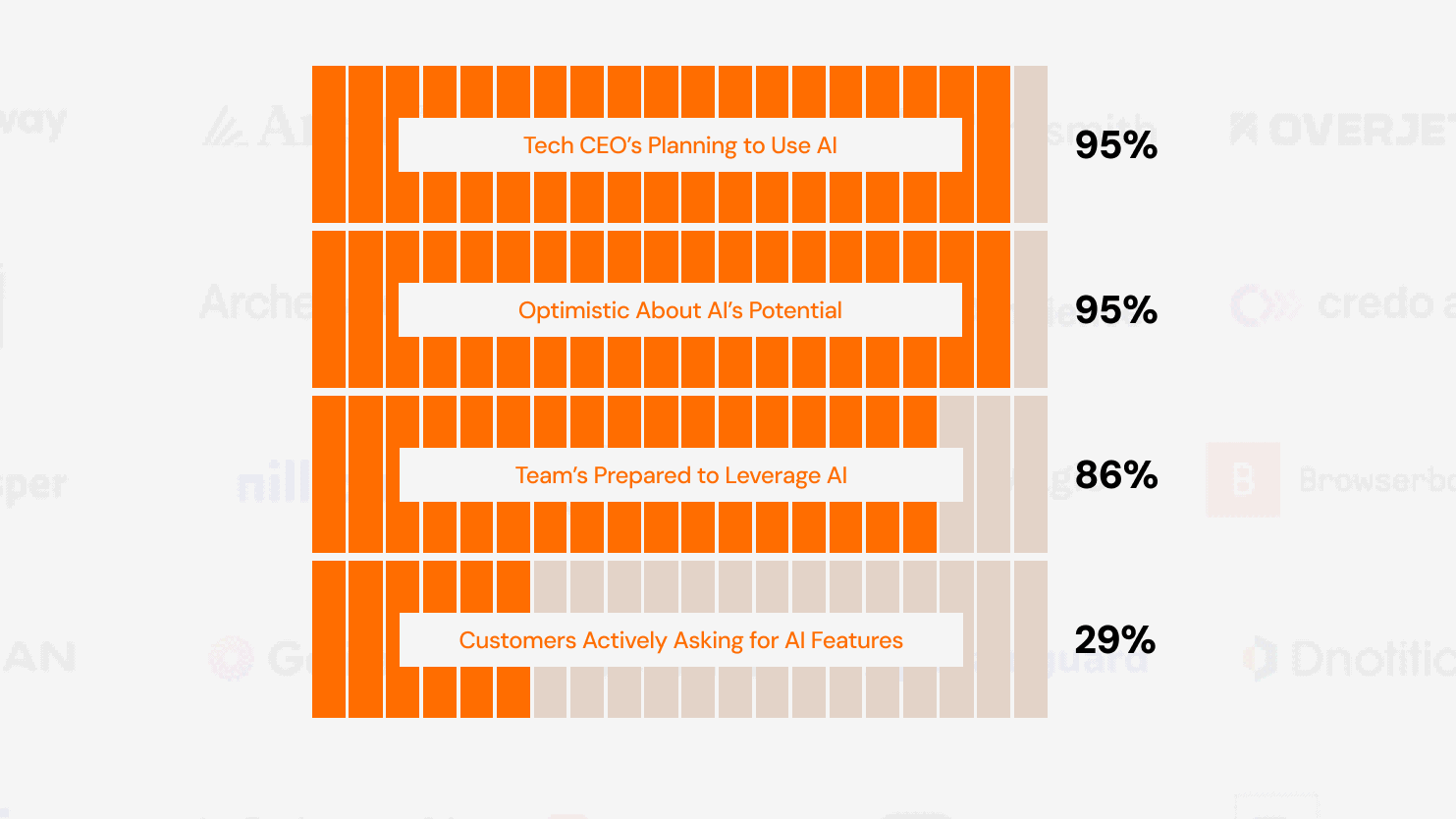
To understand how widespread that confidence is, a few survey numbers stand out:
- 95% of tech CEOs plan to use AI in their business
- 95% are optimistic about AI’s potential
- 86% say their teams are prepared to leverage AI
- Yet only 29% say customers are actively asking for AI-related solutions
This contrast reveals a critical insight. While CEOs are confident in AI internally, customers are not necessarily buying “AI” as a feature. They are buying better results. Faster execution. Improved responsiveness and stronger outcomes.
That gap between belief and business impact is where execution becomes the true differentiator.
What CEOs Actually Expect AI to Deliver
When asked about outcomes, CEOs did not focus on replacing people or cutting costs. Instead, they pointed to productivity and performance gains across their existing teams.
- 33% expect AI to save time
- 27% expect increased seller productivity
- 16% expect AI to help maximize their existing workforce
- 12% expect improvements in the customer experience
Only a very small percentage cited reducing hiring needs or saving money as their primary goal. This signals a major shift in mindset. CEOs are not looking to downsize; they are looking to scale smarter.
Want to learn more about how scaling works? Review the articles below:
The Secret to Fast, Lean Growth for Tech Companies
Blended Business Model: Integrating Remote Workers, Virtual Assistants & In-Office Staff
Why AI Alone Isn’t Enough
AI has enormous potential, but it does not run itself. Tools still require setup, prompting, integration, monitoring, and consistent execution. In many organizations, that work falls to already-overloaded leaders and teams. The result is a familiar pattern: strong strategy, underwhelming follow-through.
AI does not save time on its own. Execution does.
This is where MyOutDesk becomes essential to the AI conversation.
Turning AI Strategy Into Daily Execution
MyOutDesk helps companies operationalize AI by pairing intelligent tools with trained virtual assistants who execute inside those workflows every day. Instead of executives managing dashboards, cleaning data, updating CRMs, or chasing follow-ups, MyOutDesk VAs handle the operational lift that turns AI insights into real outcomes.
For sales teams, this directly impacts productivity. AI can support forecasting, personalization, and outreach, but sellers still lose time to scheduling, data entry, proposal prep, and follow-ups. By offloading these tasks, sellers stay focused on conversations and closing, which is exactly where CEOs expect AI-driven productivity gains to show up.
Operationally, maximizing the existing workforce means removing friction. AI can identify inefficiencies, but someone still needs to implement changes, maintain systems, and ensure consistency across teams. MyOutDesk provides that execution layer, allowing internal employees to work at a higher strategic level without adding headcount.
Improving Customer Experience Without Losing the Human Touch
AI can enhance speed and insight, but customers still expect responsiveness, clarity, and accountability from real people. MyOutDesk supports customer-facing teams by managing inboxes, coordinating onboarding, and ensuring no request slips through the cracks. The result is a smoother, more reliable customer experience, one that customers feel, even if they never mention AI by name.
Why the 29% Matters
The fact that only 29% of customers are asking for AI solutions is not a weakness it is an opportunity. Customers may not ask for AI, but they notice when businesses respond faster, communicate more clearly, and operate more efficiently. Companies that quietly combine AI with strong operational execution will outperform those that market AI without delivering meaningful change.
The CEO Takeaway
AI is no longer a competitive advantage. It is an expectation. What separates leaders in the next phase of growth is their ability to operationalize AI without overwhelming their teams.
MyOutDesk exists to close that gap, transforming AI optimism into measurable productivity, stronger teams, and better customer experiences.
Execution is the strategy. Ready to execute? Schedule a call