
In the last several years, the workforce has undergone a permanent shift. Remote and hybrid work are no longer temporary adjustments. They are now standard operating models for modern businesses. The number of freelancers, contractors, and distributed professionals continues to rise as companies prioritize flexibility, speed, and cost control. By the mid-2020s, large research firms consistently reported that the majority of knowledge workers spent at least part of their week working remotely, and many organizations have since formalized remote-first or hybrid-first policies.
At the same time, businesses are operating under tighter margins. Inflationary pressure, higher wages, ongoing supply chain volatility, and rising customer expectations have forced leaders to rethink how work gets done. The question many businesses are asking in 2026 is not whether to outsource, but how to do it strategically without sacrificing quality or control. Increasingly, the answer is virtual talent. To better understand why, let’s take a closer look at key virtual assistant statistics shaping how companies scale in 2026.
Surprising Virtual Assistant Facts
Virtual assistant research continues to show steady growth in outsourced and remote support roles. Work-from-home opportunities have become more attractive to highly skilled professionals, while businesses benefit from access to experienced talent without the cost burden of traditional hiring. As global education levels rise and remote collaboration tools mature, virtual assistants are no longer limited to basic administrative tasks.
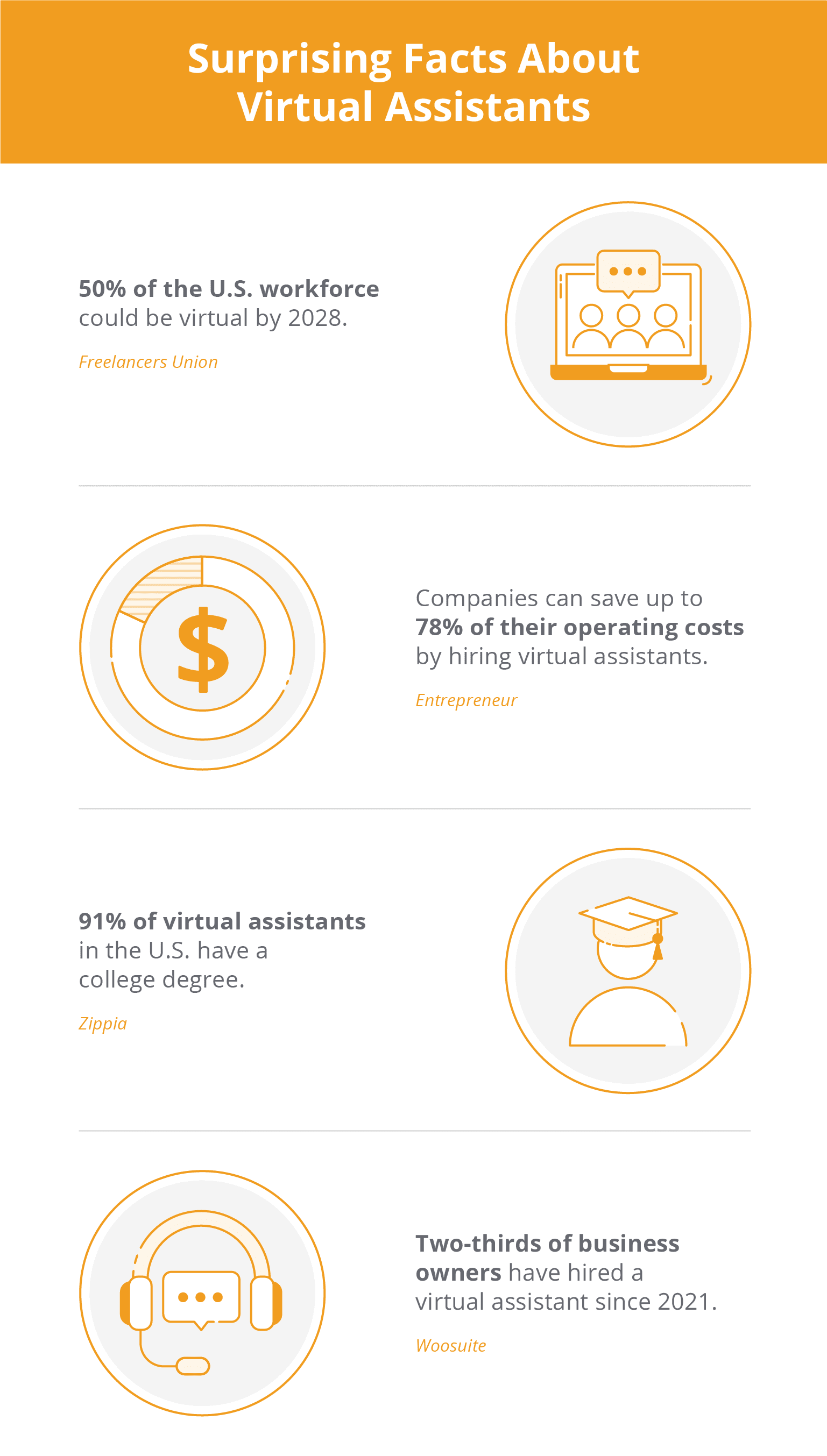
- 59% of businesses cite cost savings as the main reason for using outsourced workers. (Zippia)
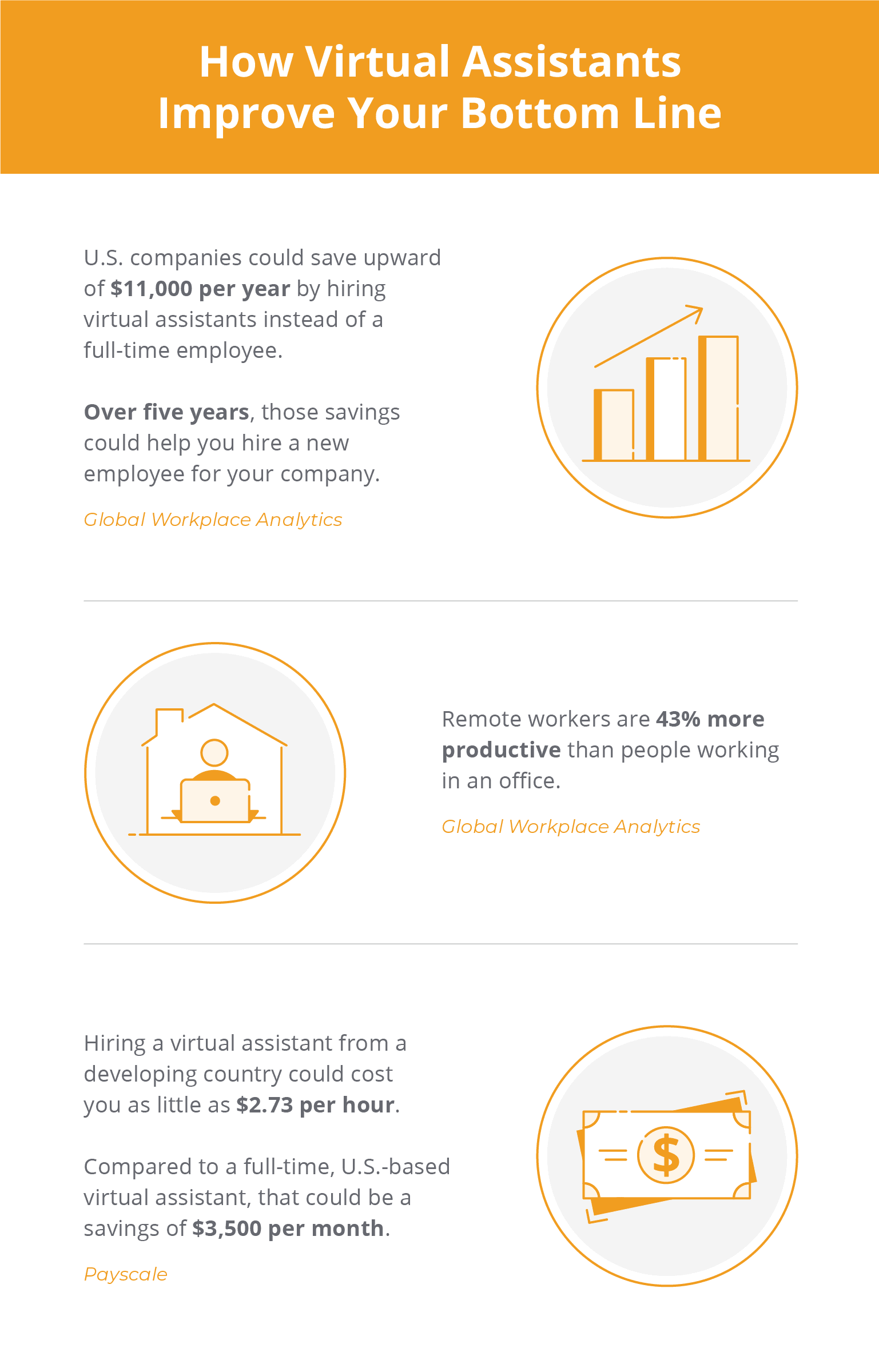
- Businesses can save as much as 78% of their operating costs by hiring virtual assistants compared to in-house workers. (Entrepreneur)
- 66% of businesses in the US outsource at least one department. (Zippia)
- 50% of the U.S. workforce could be virtual by 2028. (Freelancers Union)
- 91% of virtual assistants in the United States have a college degree. (Zippia)
- Companies across the nation have hired more than 2 million outsourced workers in the 2000s. (Zippia)
Virtual Assistant Statistics By Industry
Nearly every industry can benefit from virtual assistants, but adoption varies based on workflow complexity and customer demands. In recent years, outsourcing has expanded well beyond administrative support into revenue-generating and operational roles.
- Technology continues to lead in virtual assistant adoption, particularly in operations, QA, and support roles.
- A significant portion of top-performing real estate teams have used virtual assistants to scale transaction volume and improve response times.
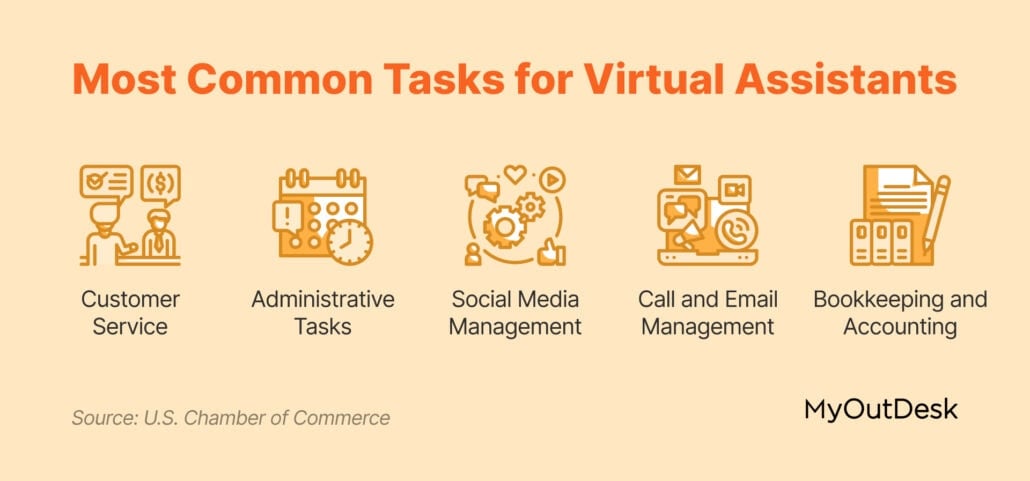
- Industries most likely to outsource include Information Technology, Finance and Accounting, Healthcare, Real Estate, and Professional Services.
Source: U.S. Chamber of Commerce
Additional trends show that many virtual assistants hold business-related degrees, making them effective across multiple industries. Customer service remains the most common entry point for virtual assistants, followed closely by administrative support, sales operations, and marketing coordination. For small and mid-sized businesses, outsourcing is frequently used to improve efficiency, reduce burnout, and allow internal teams to focus on higher-value work.
Virtual Assistant Statistics By Profession
Virtual assistants come from diverse professional backgrounds. Many previously worked as administrative assistants, customer support specialists, project coordinators, or operations managers. These roles translate well to virtual environments, where attention to detail, communication, and adaptability are essential. In 2026, virtual assistants are increasingly embedded into sales teams, executive operations, marketing departments, and customer experience workflows rather than operating on the margins of the business.
Virtual Assistant Demographics
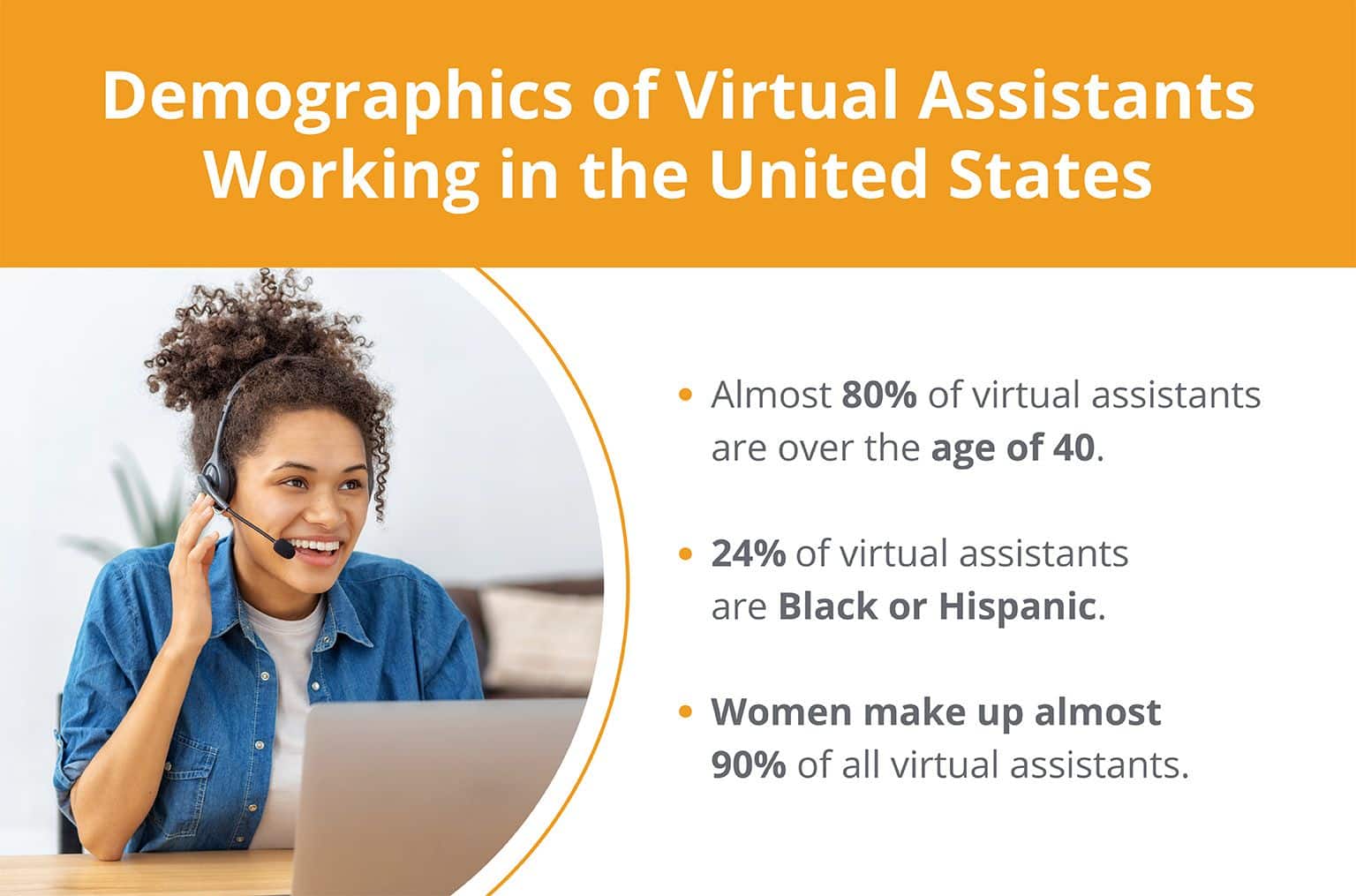
The virtual assistant workforce also reflects a broad and increasingly diverse talent pool. Women continue to make up the majority of virtual assistants, though male participation has steadily increased over the last decade. In the U.S., many virtual assistants are mid-career professionals, often bringing years of prior corporate or agency experience. Racial and ethnic diversity within the virtual assistant workforce further expands access to multilingual and culturally fluent talent, which is especially valuable for customer-facing roles.
Virtual Assistant Salary Statistics
One of the most compelling reasons businesses continue to hire virtual assistants is cost efficiency. Even when hiring U.S.-based virtual assistants, companies typically save significantly compared to hiring full-time employees with benefits, office space, and payroll overhead.
- Most virtual assistants are paid hourly or on flexible contracts.
- U.S. virtual assistants with early career experience earn competitive salaries, while highly experienced professionals command higher rates comparable to specialized in-house roles.
- Average hourly rates for U.S. virtual assistants generally fall in the low-to-mid $20s per hour, depending on skill set and experience.
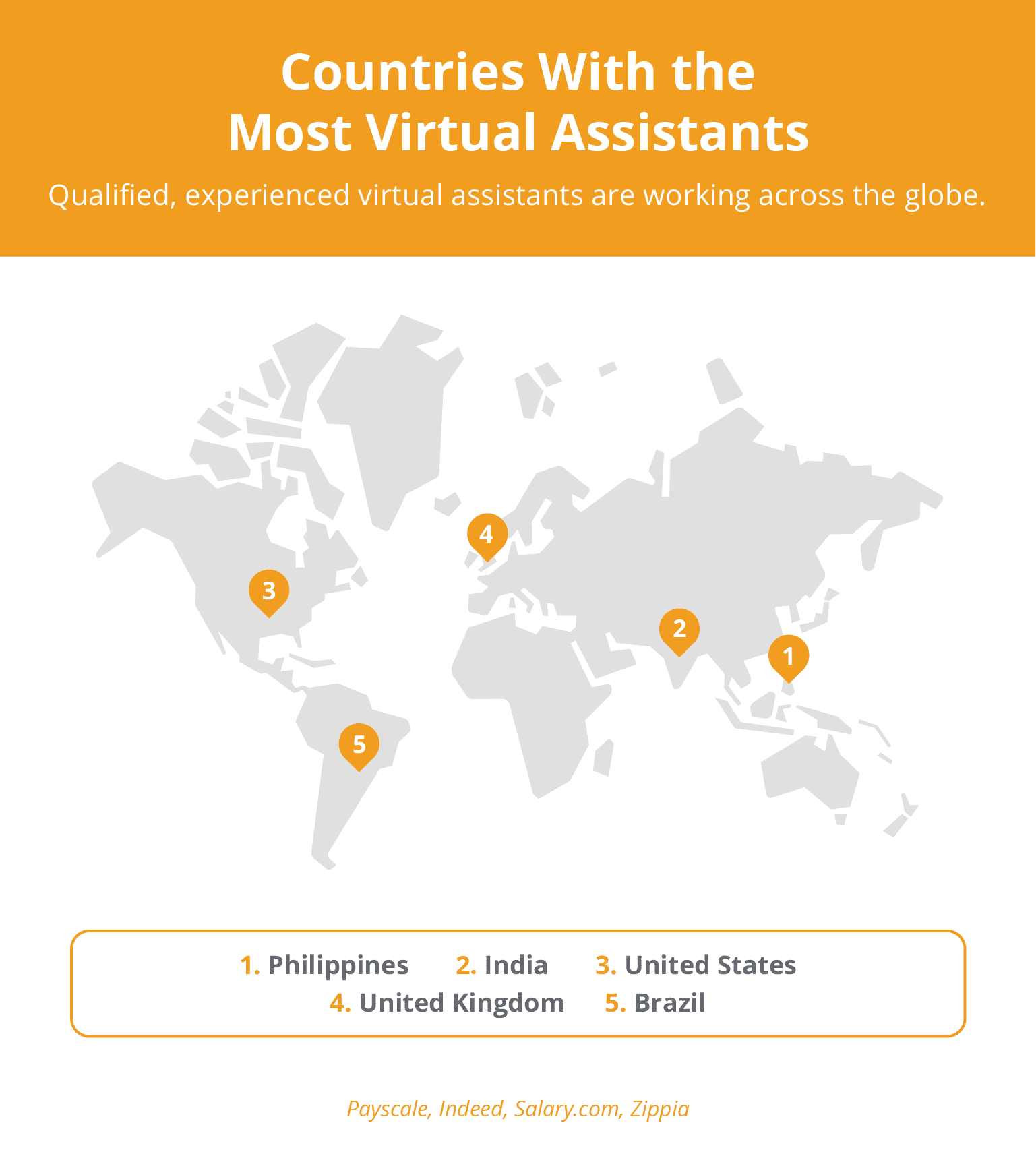
For businesses hiring globally, the cost savings can be even more substantial, while still maintaining high standards through managed services and structured oversight.
Benefits Of Hiring Virtual Assistants
Because virtual assistants work remotely, businesses save on office space, equipment, benefits, and long-term employment risk. Virtual assistants can be hired full-time, part-time, or for specific functions, giving leaders flexibility as business needs change.
- Full-time virtual assistants can reduce annual operating costs by up to 70–80%.
- Remote teams consistently report higher productivity compared to fully in-office models.
- A large percentage of work handled by virtual assistants was previously performed by in-house staff, often at a much higher cost.
- Virtual assistants tend to take fewer sick days and experience lower burnout when workloads are well managed.
- Multiple studies continue to show measurable productivity gains in remote and distributed teams.
If your company is looking to scale efficiently in 2026 without adding unnecessary overhead, virtual assistants remain one of the most practical and proven solutions. Understanding the data is the first step. The next step is finding the right talent and structure to support your growth. And if you’re reading this blog on our website, then you’ve already found it… Let’s talk!
Virtual Assistant Statistics FAQs
Have questions after reading our virtual assistant statistics? We have answers.
About The Author

Dan is a Remote Staffing Specialist and B2B copywriter with over eight years of communication experience. For the last four years, he has been deeply embedded in the virtual assistant industry, translating complex outsourcing strategies into actionable guides, case studies, and insights that help business owners scale.
Related Posts
-
 Hiring, Virtual Assistants
How Much Does an HR Virtual Assistant Cost in 2026? (Complete Pricing Guide for Small Businesses)
Outsourcing HR can save a small business 40–70% compared to hiring a full-time in-house HR manager, whose average total compensation exceeds $153,875/year (salary plus benefits and overhead).
Read more -
 Hiring
How To Hire a Virtual Assistant: The Complete 2026 Guide
Unlocking the benefits of hiring a virtual assistant can transform your business. From cutting costs to boosting productivity and enhancing flexibility, a skilled virtual assistant is a game-changer for achieving your goals. Ready to make the leap? If you’ve decided that a virtual assistant is the right solution to elevate your business, it’s time to focus on making your first hire a resounding success. The key? Hiring the right virtual assistant for your needs.
Read more -
 Hiring
Blended Business Model: Integrating Remote Workers, Virtual Assistants & In-Office Staff
The modern workforce is blended—uniting in-office staff, remote employees, and virtual assistants into one high-performing team. Learn why more companies are adopting this model, common pitfalls to avoid, and how to implement it successfully.
Read more -
 Hiring
The 6 Best Real Estate Virtual Assistant Companies – 2026 Update
Enhance your business with insights highlighting the best real estate virtual assistant companies. Discover tailored solutions to streamline operations, optimize client interactions, and drive success in the competitive real estate market.
Read more -
 Hiring, Virtual Assistants
Top Tools for Measuring Employee Satisfaction in 2026
These are the most effective employee satisfaction measurement tools that help organizations understand how their teams feel and identify areas for improvement.
Read more -
 Hiring
8 Best Virtual Assistant Companies of 2026
Explore the best virtual assistant companies expertly curated by MyOutDesk. We’ll help you find top virtual assistance solutions that cater to your business needs, enhancing productivity, fostering scalability and streamlining operations.
Read more -
 Healthcare, Hiring, Virtual Assistants
Executive Insights: Solving The Healthcare Talent Shortage with Virtual Teams
The healthcare industry in the United States is grappling with a severe talent shortage that threatens the quality and accessibility of patient care. According to the Association of American Medical Colleges (AAMC), the US could face a deficit of approximately 139,000 doctors by 2033. Additionally, the US Department of Health and Human Services reports that … Read more
Read more -
 Hiring
Outsourcing To The Philippines: Pros, Cons & More
The Philippines is one of the top destinations where major corporations outsource their business needs too, allowing businesses to keep overhead down on expenses such as office space, equipment, internet connection, taxes, and even benefits.
Read more -
 Hiring
The 5 Best Virtual Receptionist Services of 2026
Discover 5 leading virtual receptionist service options in MyOutDesk’s comprehensive guide. Explore how these services can revolutionize your business communication, providing efficiency and professionalism for unparalleled customer interactions.
Read more -
 Hiring
Fiverr vs. Upwork: Comparing Workflow, Cost, and Freelance Talent For Your Business
Unsure about Fiverr vs. Upwork? MyOutDesk’s blog delves into the comparison, offering insights to help you choose the right freelance platform for your projects. Make informed decisions and maximize your freelancing opportunities with this comprehensive guide.
Read more -
 Hiring
The 8 Best Upwork Alternatives of 2026
Exploring options beyond Upwork? MyOutDesk’s blog offers valuable insights into the 8 best Upwork alternatives. Find tailored platforms with solutions to suit your business needs and achieve new levels of growth and success.
Read more -
 Hiring
What Is a Hybrid Business? Definition, Benefits, Examples, and More
By blending in-house teams with outsourced virtual assistants, businesses are optimizing productivity and cost-effectiveness. Common among US corporations, this approach bolsters operational efficiency, cost reduction, and business growth. With perks such as improved flexibility, cost savings, and amplified efficiency, firms like MyOutDesk offer specialized virtual assistant services to help businesses maximize these benefits.
Read more