
Zillow and Realtor.com remain two of the most widely used real estate platforms in the industry. Both offer tools for property searches, agent visibility, and home value estimates. However, the differences in data sources, accuracy, lead models, and user experience can significantly impact how useful each platform is for real estate professionals.
With no shortage of real estate websites and apps available today, deciding where to invest your time and marketing budget is not always straightforward. Many agents and brokers find themselves weighing Zillow against Realtor.com and asking which platform delivers more value. This guide breaks down how the two compare in 2026, so you can decide which aligns best with your business goals.
What is Zillow?
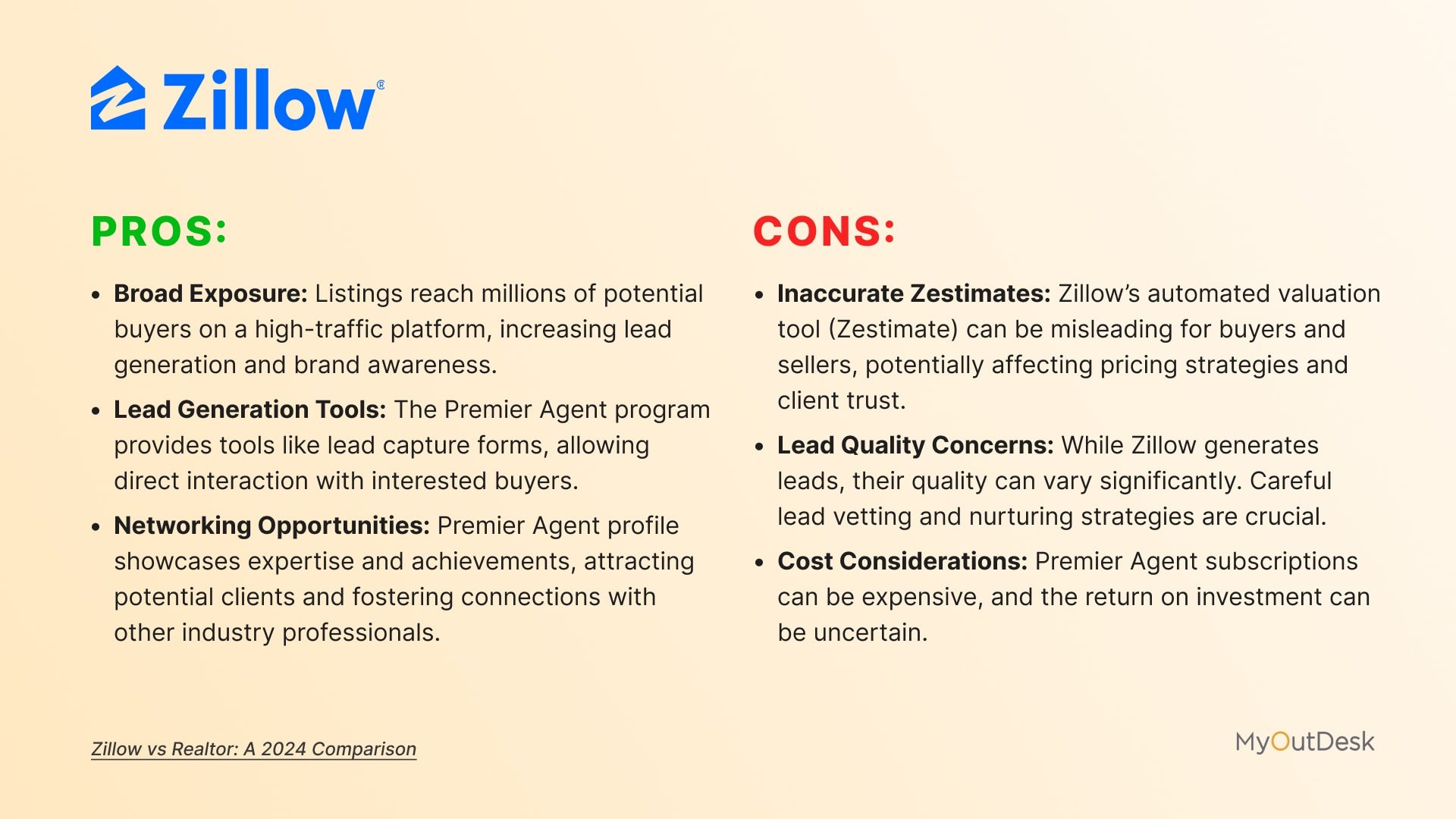
Zillow is an online real estate marketplace generally known for its user-friendly tools, including a free MLS search. Having started as a real estate valuation website, Zillow has expanded into the realm of allowing users to post reviews about individual agents and brokerages in the country.
Their website features consumer and agent tools, home value estimates for specific homes, and even home price forecasts down the line—all free of charge. Zillow does not list any agents or brokers; rather, the company uses third-party listings from active real estate agents and brokerages nationwide.
Pros
Broad exposure
Zillow listings are viewed by millions of users each month, making it one of the highest-traffic real estate platforms available. This level of exposure can increase brand awareness and generate a steady flow of leads, especially in competitive markets.
Lead generation tools
Zillow’s Premier Agent program offers lead capture tools, enhanced profile visibility, and advertising options that allow agents to connect directly with active buyers. Features like Instant Offers can also introduce sellers earlier in the decision process.
Networking and branding
Premier Agent profiles highlight experience, reviews, and recent transactions, which can help newer agents build credibility and more established agents reinforce their reputation.
Cons
Inconsistent home value estimates
Zillow’s Zestimate can be inaccurate, particularly for unique properties or homes with recent upgrades not reflected in public data. Agents often need to spend time educating clients on the limitations of automated valuations.
Variable lead quality
While Zillow can generate a high volume of leads, not all inquiries are well-qualified. Agents may need strong follow-up systems to filter and convert opportunities effectively.
Cost considerations
Premier Agent advertising can become expensive, and results vary by market. Without careful tracking, return on investment can be difficult to measure.
What is Realtor.com?
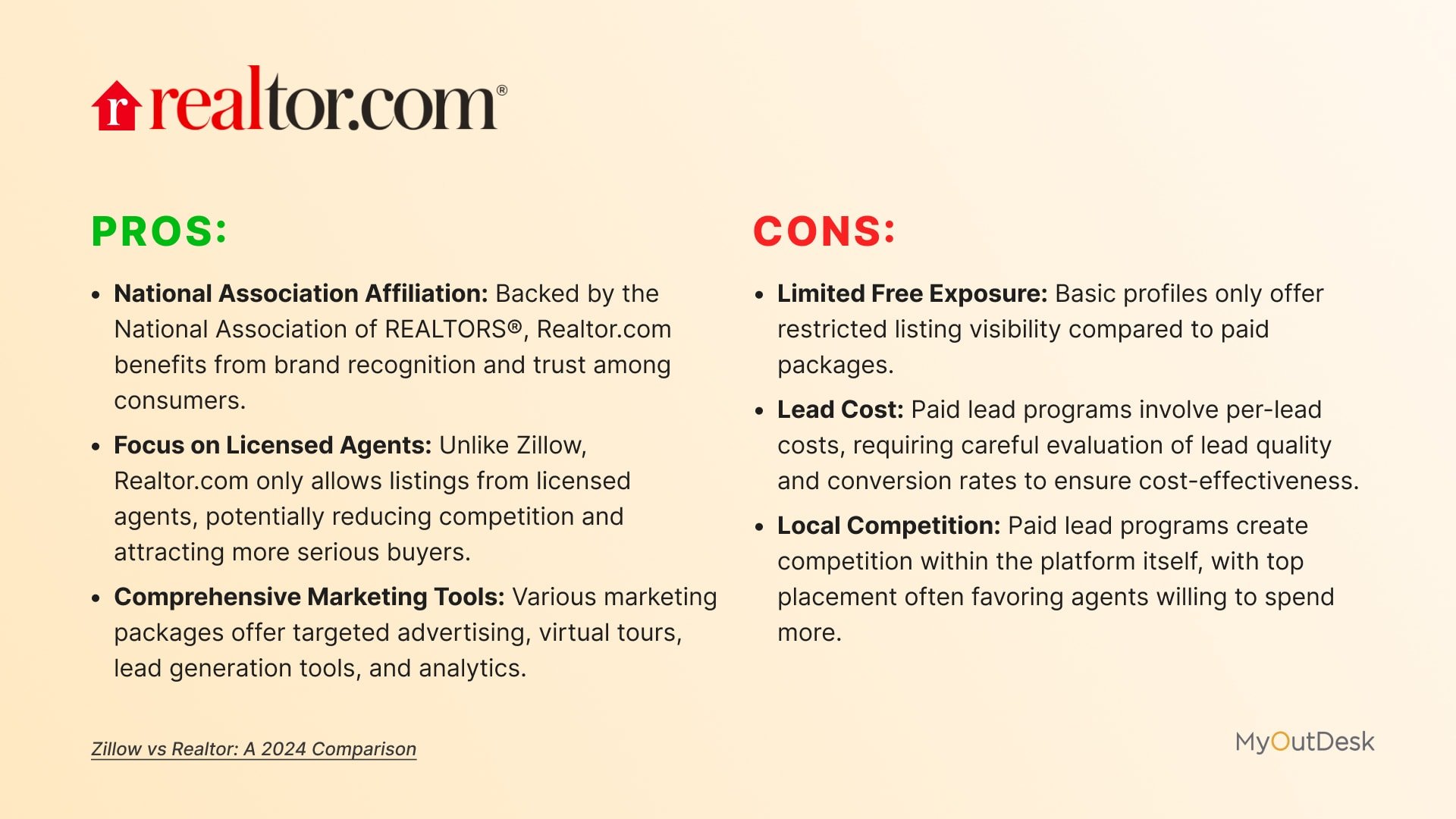
Realtor.com is a real estate platform operated in partnership with the National Association of REALTORS®. It focuses exclusively on listings represented by licensed agents and brokers, emphasizing data accuracy and professional credibility.
In addition to property listings, Realtor.com provides market insights, agent marketing tools, mortgage information, and lead generation programs designed to connect agents with buyers actively searching for representation.
Pros
Association with the National Association of REALTORS®
This affiliation reinforces trust and credibility, particularly among consumers who value working with licensed professionals.
Licensed-agent listings only
Realtor.com limits listings to those submitted by licensed agents, which can reduce competition from unrepresented sellers and attract more serious buyers.
Robust marketing tools
Paid packages include targeted advertising, virtual tours, analytics, and lead programs that allow agents to focus on specific markets and buyer profiles.
Cons
Limited free exposure
Agents relying solely on free profiles may see minimal visibility compared to paid competitors, particularly in high-demand areas.
Per-lead pricing model
Lead programs require careful budgeting and performance tracking to ensure costs align with conversion rates.
Platform competition
Top placement often favors agents willing to invest more, which can be challenging for newer or budget-conscious professionals.
Key Differences Between Zillow vs. Realtor.com
Lead Quality and Conversion
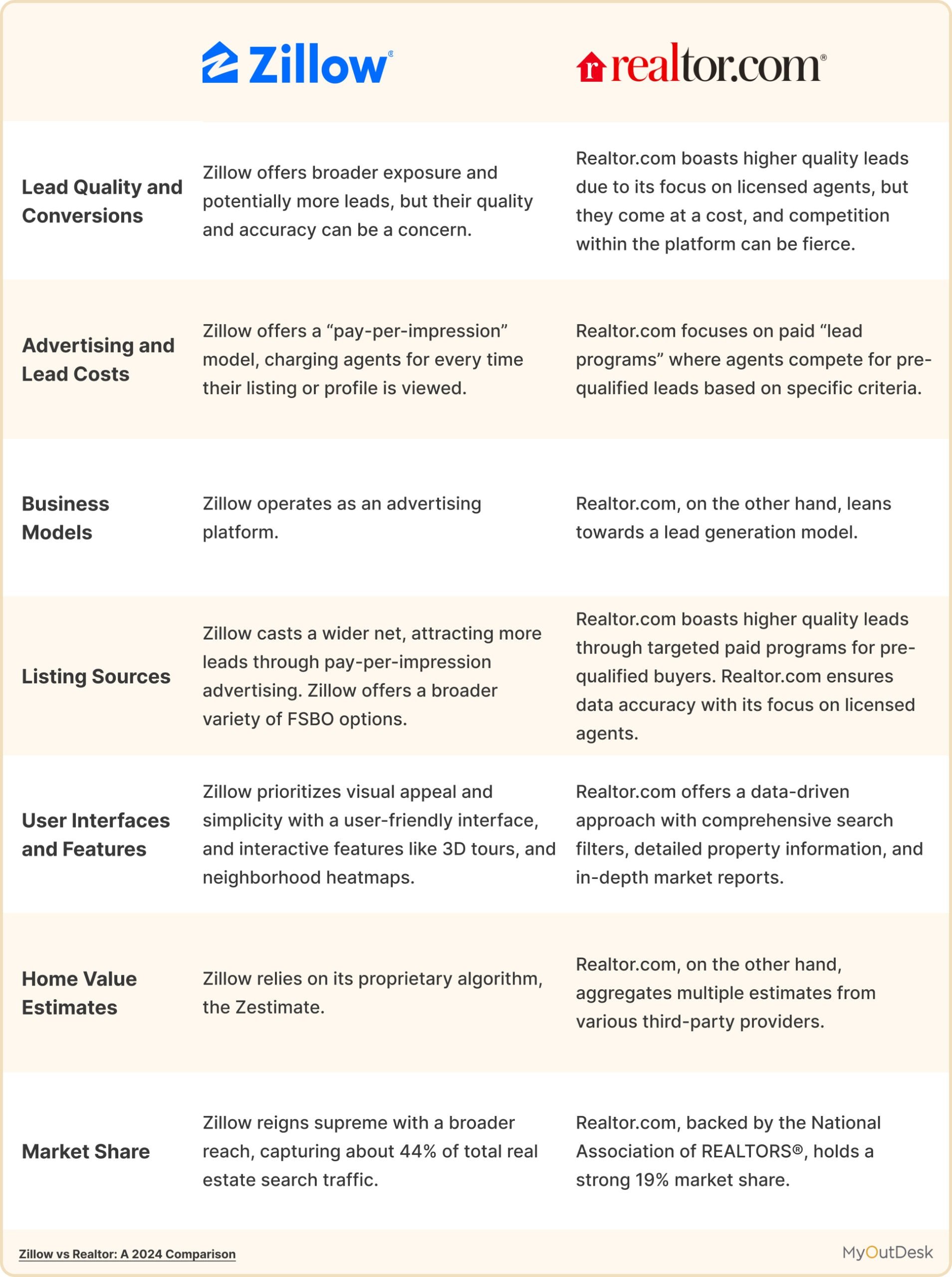
Zillow prioritizes reach and volume, which can result in more leads but less consistency in quality. Realtor.com generally delivers fewer leads, but they are often more qualified due to its licensed-agent focus. Success on either platform depends on follow-up speed, lead nurturing, and internal systems.
Advertising and Lead Costs
Zillow primarily operates on a pay-per-impression model, charging agents based on exposure rather than lead qualification. Realtor.com uses a pay-per-lead approach, offering more targeted opportunities at a higher per-lead cost. Each model requires a different budgeting and conversion strategy.
Business Models
Zillow functions primarily as an advertising platform, generating revenue through agent subscriptions and consumer advertising. Realtor.com operates more as a lead marketplace, monetizing access to buyer inquiries based on location and criteria.
Listing Sources
Zillow includes MLS data as well as for-sale-by-owner listings, which can expand reach but introduce inconsistencies. Realtor.com focuses on MLS-sourced, agent-represented listings, prioritizing accuracy over breadth.
User Interface and Features
Zillow emphasizes visual appeal and ease of use, offering tools like 3D tours and neighborhood maps. Realtor.com leans into detailed filters, market data, and analytics, appealing to users who prefer deeper insights over presentation.
Home Value Estimates
Zillow provides a single automated Zestimate, which can be useful for quick reference but is not always reliable. Realtor.com aggregates estimates from multiple providers, offering a range of values that may better reflect market variability. Neither replaces a professional appraisal.
Market Share
Zillow continues to capture a larger share of consumer real estate search traffic, driven by aggressive marketing and broader listing inclusion. Realtor.com maintains a smaller but more focused audience centered on licensed representation. The better choice depends on whether exposure or data integrity is the priority.
How To Leverage Leads From Both Platforms
Many successful agents use Zillow and Realtor.com together rather than choosing one exclusively. The key is having systems in place to respond quickly, qualify leads efficiently, and follow up consistently.
MyOutDesk provides full-time real estate virtual assistants who support agents by managing Zillow and Realtor.com leads, handling follow-ups, updating CRMs, and maintaining communication workflows. By outsourcing lead management, agents can focus more time on client relationships and closings while improving response times and conversion rates.
Both platforms can be valuable tools in 2026 when paired with the right support and strategy.
Book a Free Strategy Call
About The Author

Dan is a Remote Staffing Specialist and B2B copywriter with over eight years of communication experience. For the last four years, he has been deeply embedded in the virtual assistant industry, translating complex outsourcing strategies into actionable guides, case studies, and insights that help business owners scale.
Related Posts
-
 Real Estate, Virtual Assistants
The Best Real Estate CRM Software In 2026
Choosing the right real estate CRM can transform your business. This 2025 comparison guide reviews the top platforms, so you can scale smarter and serve clients better.
Read more -
 Real Estate, Virtual Assistants
The Lead Follow-Up Gap: How Many Deals Are You Losing by Not Following Up Fast Enough?
In real estate, speed matters. The lead follow-up gap can cost you deals and revenue. Learn how to close this gap, respond faster, and convert more leads with the help of Virtual ISAs from MyOutDesk.
Read more -
 Real Estate
What is Circle Prospecting in Real Estate? (Benefits, Tips, and How to Use VAs)
Discover everything you need to know about circle prospecting in real estate! Learn how this powerful lead-generation strategy can help you secure more listings, build brand awareness, and keep your pipeline full. From essential tips to maximize your results to leveraging virtual assistants (VAs) for seamless execution, this guide covers it all.
Read more -
 Administrative, Real Estate, Virtual Assistants
Simplify AirBnb Management: The Power of Virtual Assistants
Managing an Airbnb or short-term rental can be overwhelming, but it doesn’t have to be. Learn how a skilled virtual assistant from MyOutDesk can handle guest communication, admin tasks, marketing, and more—helping you run your rental like a pro.
Read more -
 Real Estate, Virtual Assistants
What is Dotloop?
Discover how Dotloop can transform real estate transactions by simplifying document management, digital signatures, and workflows all in one place. This powerful tool is designed to enhance efficiency and save time, but that’s just the beginning. Learn more about the key benefits of Dotloop and how it can elevate your real estate business.
Read more -
 Administrative, Real Estate
What Is A Transaction Coordinator?
A real estate transaction coordinator manages the administrative side of property deals, ensuring smooth and timely closings. By handling tasks like paperwork, deadlines, and communication, they allow agents to focus on client relationships and revenue-generating activities. Learn how a virtual assistant from MyOutDesk can boost your business productivity.
Read more -
 Real Estate, Virtual Assistants
Boost Your Real Estate Business with Virtual Teams: Thriving in Tough Markets
In the ever-evolving real estate market, professionals face significant challenges. Today, realtors grapple with tripled interest rates, a one-third drop in transaction volumes, and record-low NAR membership since October 2022. The recent NAR settlement further complicates the landscape. Despite these hurdles, drawing on past experiences can provide valuable insights for navigating current and future uncertainties. … Read more
Read more -
 Real Estate
9 Awesome Real Estate Apps
Dive deep into the world of real estate apps, where we’ve cherry-picked tools that blend affordability with functionality, ensuring your remote team stays agile and connected. From Trello’s transparent project management to HubSpot’s dynamic CRM prowess, these platforms reshape the way Realtors® operate. And for those eyeing an edge without the overhead, MyOutDesk’s virtual assistants stand ready to manage, innovate, and optimize at a fraction of the cost.
Read more -
 Real Estate
Why You Need A Virtual Real Estate Transaction Coordinator!
Most real estate agents & brokers are already familiar with the role of virtual assistants in prospecting & administrative work – but there’s another pivotal role that virtual assistants can assist with, which is serving as a virtual real estate transaction coordinator.
Read more -
 Real Estate
How to best leverage Dotloop: Real Estate Transaction Management Solution
Dotloop streamlines real estate transactions with digital solutions, boosting closings by 60% through predictive analytics. While many CRMs drain budgets, Dotloop’s innovation leads the market, further optimized by cost-effective virtual assistants that manage tedious tasks, ensuring agents can prioritize growth. Harness the power of tech and outsource to enhance your real estate hustle, trimming expenses and driving profit.
Read more -
 Real Estate
Real Geeks and a Virtual Assistant: What You Need to Know
Hiring a virtual assistant (VA) can help real estate professionals using Real Geeks increase productivity and save time. With VA support, agents can streamline their business and focus on revenue-generating activities, while VAs handle administrative tasks, lead generation, marketing, and other duties.
Read more -
 Real Estate
Vulcan 7 & Your Virtual Assistant
Equipping your Real Estate ISA with the most effective prospecting tools is crucial for achieving success. With several years of industry experience and having served over 6,500 clients with diverse business setups, needs, and objectives, we’ve gained invaluable insights into identifying tools that complement their operations. That’s why we’re sharing this wealth of knowledge, detailing various tools and their features. Our accumulated wisdom from collaborating with clients can serve as a valuable guide as you navigate and select the tools best suited to your needs.
Read more