
Customer service outsourcing can mean very different things depending on the provider. Some companies take over your entire support operation. Some provide 24/7 managed contact center coverage. Some specialize in AI-assisted support. Others, like MyOutDesk, place dedicated virtual assistants who work inside your existing help desk, CRM, inbox, phone system, scripts, and escalation process.
Customer service is the most outsourced function in the world. According to PWC’s 2024 Global Outsourcing Survey, 38% of businesses outsource customer service, more than any other operational function. So the question for most leaders is not whether to outsource customer support, it is which model fits the team they actually have.
If you need a global multilingual contact center with hundreds of agents, a traditional BPO like Teleperformance, Concentrix, or TTEC may be the right fit. If you already have a support process and need more trained capacity without taking on the recruiting, vetting, replacement, or HR work, an embedded customer service virtual assistant model is the closest match.
This guide compares the top providers by use case, team model, pricing model, onboarding speed, security posture, and ideal buyer.
Table of Contents
- Quick Comparison: Best Customer Service Outsourcing Companies
- How We Chose These Providers
- Best Providers (Ranked)
- Other Notable Providers
- What Is Customer Service Outsourcing?
- Outsourcing vs. Staff Augmentation
- What Customer Service Outsourcing Costs in 2026
- Tasks You Can Outsource
- Pros and Cons
- 2026 Trends
- How to Choose a Provider
- FAQs
Disclosure: This guide is published by MyOutDesk and recommends MyOutDesk for one specific buyer profile: companies that want dedicated, vetted customer service virtual assistants who work inside their existing tools and workflows under their direction. Where MyOutDesk is not the best fit, we name the providers that are, such as major BPOs for enterprise scale, and specialized providers for industries. Use this guide as a starting point and verify any pricing, certifications, or capabilities directly with each provider.
Quick Comparison: Best Customer Service Outsourcing Companies
| Provider | Best For | Team Model | Pricing Model | Public Security / Compliance Notes | Ramp Profile | Best Fit |
|---|---|---|---|---|---|---|
| MyOutDesk | Embedded customer service virtual assistants | Dedicated VA in your systems | Contract minimum (6 or 12 months) | SOC 2, HIPAA, CIS Level 2 hardened devices | As little as 1 week | Companies wanting to expand in-house customer service teams |
| Influx | Flexible managed customer support | Managed support team | Month-to-month, pay-as-you-go or custom | Public pages emphasize managed QA, training, 24/7 coverage, and existing-tool integration. Verify security requirements in procurement. | Start in about 1 week for simpler setups | Growing brands with fluctuating volume |
| Hugo | AI-enabled 24/7 support | Managed CX team | Custom, month-to-month options published | Public pages list ISO 27001, SOC 2, GDPR, HIPAA, and clean-room/security options | Pilot in about 1 week, launch around 1 month | Startups and digital-native brands |
| SupportYourApp | Omnichannel support focused on tech companies | White-label managed support | Custom | Public pages list PCI DSS Level 1, ISO 27001, GDPR, CCPA, and HIPAA compliance | Mid-complexity ramp | SaaS, fintech, healthtech, apps |
| Helpware | White-label industry-specific support | Managed BPO and CX | Hourly or custom | Public pages reference SOC 1 and 2 standards, GDPR, HIPAA-aligned practices, and PCI DSS | Mid-complexity ramp | Mid-market and enterprise teams |
| TaskUs | High-growth tech and trust/safety | Managed BPO | Custom | Public AI/data pages list PCI-DSS Level 1, SSAE 16 Type II, ISO, HIPAA, and HITRUST certifications | Enterprise ramp | Tech platforms, AI operations, trust and safety |
| Teleperformance | Global enterprise scale | Managed BPO | Enterprise custom | Enterprise security and compliance vary by region and solution. Verify standards during procurement. | Enterprise ramp | Large multilingual operations |
| Concentrix | Enterprise CX analytics | Managed BPO and CX transformation | Enterprise custom | Public cybersecurity pages list ISO 27001, ISO 27032, ISO 22301, ISO 22320, SOC 2, and GDPR | Enterprise ramp | Large complex support organizations |
| TTEC | CX technology plus managed operations | Managed BPO and consulting | Custom | Public pages reference PCI-DSS, ISO/IEC 27001, HITRUST, FedRAMP, and HIPAA-related capabilities across specific platforms/solutions | Enterprise ramp | Enterprise omnichannel CX |
How We Chose These Providers
We compared providers by the factors that matter most when a company is deciding whether to outsource customer service:
- Support model: managed BPO, embedded VA staffing, recruiting placement, freelance marketplace, or AI-human hybrid
- Channel coverage: phone, email, live chat, social media, help desk, technical support, and back-office customer operations
- Best-fit company size: small business, mid-market, enterprise, or high-growth startup
- Pricing transparency or pricing model
- Security and compliance posture, including SOC 2, HIPAA, GDPR, PCI-DSS, ISO 27001, HITRUST, and related frameworks where publicly listed
- Onboarding speed and ramp complexity
- Brand-control model: vendor-managed support vs. client-managed support
- Ability to preserve customer context inside the client’s existing tools
- Whether the provider’s public materials match the buyer profile we assign
No provider is best for every business. The right choice depends on whether you want to replace your support operation, extend your current team, recruit your own remote employees, add after-hours coverage, reduce ticket backlog, support multiple languages, or combine AI automation with human agents.
MyOutDesk: Best for Embedded Customer Service Virtual Assistants
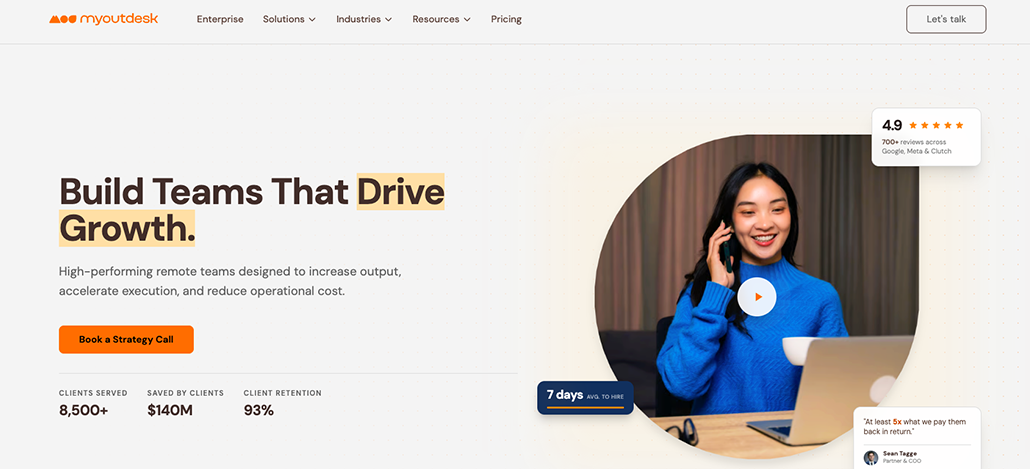
MyOutDesk is the best fit for companies that already have customer service processes, tools, and team leadership in place but need more capacity without hiring full-time U.S. employees, recruiting their own remote staff, or handing the customer relationship to a traditional BPO.
Unlike a managed contact center, MyOutDesk provides dedicated customer service virtual assistants who work inside your existing help desk, CRM, inbox, phone system, and SOPs. Your team keeps control of the customer relationship. MyOutDesk handles sourcing, vetting, placement, HR support, remote team infrastructure, and replacement support if the fit is wrong.
This model works especially well for companies that need customer support outsourcing but do not want to lose direct control of the customer experience.
Customer service virtual assistant tasks include:
- Phone, email, live chat, and social media inquiries
- Help desk ticket creation, prioritization, resolution, and escalation
- Order updates, returns, refunds, and shipment tracking
- CRM updates, customer records, case notes, and support reporting
- CSAT and NPS survey administration
- Quality assurance workflows
- FAQ and knowledge base maintenance
- Tier-1 ticket handling with escalation to senior internal agents
Pros:
- You keep full control of the customer relationship, brand voice, and day-to-day agent management
- Dedicated full-time customer service virtual assistants, not shared freelance agents
- VAs work inside your tools, scripts, macros, and escalation process. No vendor stack lock-in.
- Rematch coverage at no extra cost if the fit is wrong, so quality issues do not turn into months-long retraining cycles
- 6-stage vetting process with a 0.7% pass rate, according to MyOutDesk’s customer service VA page
- As little as 1 week to hire or onboard, according to MyOutDesk’s comparison table
- Pricing starts at $1,988/month on the MyOutDesk pricing page
- Flat monthly pricing instead of unpredictable per-ticket markups
- Up to 70% savings compared with traditional in-house hiring
- Month-to-month engagements available, with no long-term BPO contract required
- SOC 2, HIPAA, CIS Level 2 security devices available
Cons:
- Not built to run an independent 100-seat multilingual contact center on your behalf. If you want a vendor to fully own the operation, an enterprise BPO is a better fit.
- Requires you to have a working customer service process, SOPs, and management capacity. The embedded VA model assumes someone on your side leads the work.
- Multilingual support is narrower than enterprise BPOs that staff in 100+ languages
- Built for SMB and mid-market buyers. Not the right fit for enterprise procurement teams that require RFP-driven contact-center transformation programs.
Industries served: MyOutDesk has placed customer service virtual assistants across real estate, mortgage, healthcare, insurance, financial services, ecommerce, professional services, and SMB operations. Vertical specialization matters when a customer service VA needs to navigate a specific tool stack, regulatory environment, or industry vocabulary.
Delivery footprint: MyOutDesk was founded around Philippine virtual talent and now lists office or talent hubs in the United States, the Philippines, Peru, and Morocco. That gives U.S. companies options for offshore, nearshore, and expanded-hours support depending on the role and coverage plan.
Pricing: MyOutDesk’s pricing page lists virtual assistants starting at $1,988/month. Current pricing can vary by role, hours, specialization, and service package, so use the pricing page or savings report for the current quote. For broader context on what virtual assistant capacity should cost, see virtual assistant cost.
Best for: SMB and mid-market companies that want to add 1 to 10 dedicated customer service virtual assistants without replacing their existing support leadership.
Where MyOutDesk is not the right fit:
- Companies that need a 200-seat multilingual contact center that independently manages the entire support operation. Look at Teleperformance, Concentrix, TTEC, or Foundever instead.
- Companies that want to recruit and directly employ a global remote hire on their own payroll rather than use a placement-and-staffing model. A recruiting service such as Somewhere is a better fit for that use case.
- Companies whose primary need is European-language support across the EU and UK. Look at Transcom, Atento, or a regional European provider.
- Companies that need deeply specialized trust and safety, content moderation, or AI data labeling operations. Look at TaskUs.
- Companies that want a fully managed AI-first support stack with platform pricing. Look at Hugo or AI-human hybrid platforms.
Ready to compare a customer service VA against a BPO contract? Talk to a MyOutDesk advisor or see how the embedded VA model works.
Influx: Best for Flexible Managed Customer Support
Influx is a strong option for growing companies that need managed customer support without building a large in-house team. It is commonly considered by ecommerce, SaaS, marketplace, and subscription businesses that need reliable coverage across email, chat, social, voice, and other digital support channels.
Influx’s public pages emphasize 24/7 support, month-to-month pricing, no lock-in contracts, pay-as-you-go pricing, existing-tool integration, and start-in-one-week messaging. That makes it a strong fit for teams that want a managed support operation with more flexibility than a traditional enterprise BPO contract.
Where Influx differs from an embedded VA model is ownership. With managed support, the vendor is more involved in running the support function. That can be useful if you want operational support, reporting, and coverage handled externally. It may be less ideal if you want every agent reporting directly through your internal team.
Pros:
- Flexible managed support without long-term lock-in contracts
- Month-to-month and pay-as-you-go pricing options
- 24/7 coverage across email, chat, social, and voice
- Faster to start than enterprise BPO programs
- Can integrate with your existing help desk and CRM tools
Cons:
- You give up day-to-day control of agents. Your team leads do not directly manage the people responding to your customers.
- If quality drops, retraining and remediation run on the vendor’s timeline, not yours
- Switching providers later means rebuilding training, scripts, escalation rules, and product knowledge from scratch. That switching cost is real and quietly grows with tenure.
- Brand voice depends on the vendor’s hiring and training, not your standards
- Agent rotation can hurt context retention compared with dedicated embedded staffing
- Pay-as-you-go can become unpredictable as volume scales
Best for: Companies that need flexible managed support and do not want to hire, train, schedule, and oversee every agent directly.
Team model: Managed support team.
Pricing model: Month-to-month, pay-as-you-go, or custom, depending on scope.
Good fit if: You want a partner to help run customer support, especially during growth, seasonality, or volume spikes.
Not ideal if: You want a dedicated customer service virtual assistant who works as a direct extension of your internal team, with day-to-day control and the ability to swap an agent quickly if the fit is wrong.
Hugo: Fully Managed 24/7 Support
Hugo is positioned around 24/7 omnichannel customer support, AI-enabled help desk operations, 60+ languages, and fully managed teams. Its public customer support page lists month-to-month pricing, 365/24/7 coverage, AI-enabled help desk solutions, onboarding, management, QA, training, workforce management, and included team leads.
Hugo is especially useful for brands that want a managed team and global coverage without building that operation themselves. Its public materials also emphasize dedicated teams, no hidden setup fees, flexible scaling, a 30-day trial, and security certifications such as ISO 27001, SOC 2, GDPR, and HIPAA.
For buyers comparing customer support outsourcing companies, Hugo is worth considering when always-on coverage and flexible CX support matter more than direct day-to-day management of individual agents.
Pros:
- 24/7 multilingual, multi-channel managed support
- AI-enabled help desk operations
- Month-to-month options published in public materials
- Fast pilot launches
- Public security positioning includes ISO 27001, SOC 2, GDPR, and HIPAA
Cons:
- Vendor-managed model. You do not control day-to-day staffing decisions, scheduling, or coaching.
- If the team underperforms, the retraining and replacement cycle runs on Hugo’s timeline, not yours. Your customers feel the lag.
- Switching off Hugo later requires offboarding the team and rebuilding institutional knowledge. The longer you stay, the harder it is to leave.
- Brand voice and customer experience are mediated by an outside operator
- Less flexible than embedded staffing if you want a specific person reporting through your team
- Custom pricing means harder side-by-side cost comparisons
Best for: Startups and digital-native companies that want 24/7 managed support with modern workflows.
Team model: Managed CX team.
Pricing model: Custom, with month-to-month and flexible-contract messaging in public materials.
Good fit if: You need support coverage across time zones, multiple languages, and channels, and prefer an outsourced team model.
Not ideal if: You want a single dedicated customer service virtual assistant embedded directly into your organization, reporting through your team rather than a vendor delivery manager.
SupportYourApp: Fully Managed Omnichannel Support for Tech Companies
SupportYourApp is a white-label support provider that is often relevant for SaaS, fintech, healthtech, hardware, apps, and technology companies. Its public materials emphasize secure support, AI-assisted support teams, 60+ operational languages, and compliance standards including PCI DSS Level 1, ISO 27001, GDPR, CCPA, and HIPAA.
SupportYourApp can be a strong fit when customer support requires product knowledge, structured escalation, technical troubleshooting, multilingual support, and compliance-aware processes.
Pros:
- Strong public compliance posture: PCI DSS Level 1, ISO 27001, GDPR, CCPA, HIPAA
- 60+ language coverage
- White-label managed support that runs under your brand
- AI-assisted teams
- Tech-vertical experience across SaaS, fintech, healthtech, hardware, and apps
Cons:
- Fully managed model means you cede day-to-day operational control
- White-label can mask quality issues until customers escalate publicly. By then the brand damage is already done.
- Replacing the vendor mid-contract is operationally heavy and risks support gaps during transition
- Knowledge transfer back to your team or to a new vendor takes weeks. The longer the engagement, the bigger the lift.
- Custom pricing is opaque. Hard to budget for and hard to compare against other providers.
- Not a fit if you want to manage agents directly
Best for: SaaS, fintech, healthtech, apps, and companies with technical or regulated support needs.
Team model: White-label managed support.
Pricing model: Custom.
Good fit if: You need omnichannel support with stronger technical and compliance requirements.
Not ideal if: You need a low-complexity staffing model where your internal team manages the agent directly and can replace them quickly if quality drops.
Helpware: Best for White-Label Industry-Specific Support
Helpware is a customer support outsourcing provider focused on white-label, custom-built support teams across specific industries. Its customer support and customer service outsourcing pages emphasize sectors such as healthcare, SaaS, ecommerce, fintech, gaming, logistics, education, and travel.
Helpware’s public materials also emphasize AI-enabled support, 19 locations globally, 400+ brands, 90%+ CSAT, 40% to 60% savings on support costs, and security practices tied to SOC 1 and 2 standards, GDPR, HIPAA-aligned practices, and PCI DSS.
Helpware is a stronger fit for companies that want a strategic BPO partner rather than just a single support hire. It can be useful when you need broader services, more structured operations, quality assurance, reporting, and a provider that can scale with support volume.
Pros:
- White-label, industry-specific managed teams
- 19 global locations
- 400+ brands served
- Public materials cite 90%+ CSAT and 40% to 60% savings on support costs
- Strong compliance posture: SOC 1 and 2, GDPR, HIPAA-aligned, PCI DSS
- AI-enabled support workflows
Cons:
- Vendor-led BPO model. You are not the manager of record for the people serving your customers.
- If service quality slips, the retraining and remediation cycle is the vendor’s. Recovery is slower than a model where you can swap an agent yourself.
- Switching providers means rebuilding the entire support operation, including scripts, escalation rules, QA scorecards, and product training. Switching cost increases the longer you stay.
- Brand voice is delivered by people you do not hire or evaluate
- Setup fees, contract minimums, and managed-service margins can lock you into a relationship you cannot easily exit
- Reputational risk: any public quality issue at a managed BPO partner reflects on your brand, not the vendor’s
Best for: Mid-market and enterprise companies that need white-label industry-specific managed customer support.
Team model: Managed BPO and CX, white-label under the client’s brand.
Pricing model: Hourly or custom, depending on service complexity and delivery model.
Good fit if: You need a managed support partner with industry specialization, white-label brand control, and compliance depth.
Not ideal if: You want to keep day-to-day agent management fully inside your company, with no vendor delivery layer between your team and the people serving your customers.
TaskUs: Tech Focused, Trust/Safety
TaskUs is a major outsourcing provider for high-growth technology companies, digital platforms, content moderation, AI operations, trust and safety, and customer experience. It is often a better fit for complex, high-volume tech environments than for small teams looking to add one or two support agents.
TaskUs is especially relevant if customer service overlaps with moderation, user safety, marketplace operations, AI data labeling, AI model feedback workflows, fraud prevention, or complex digital support processes. Its public trust and safety materials emphasize platform safety, fraud and scam reduction, AI-powered moderation, red teaming, wellness programs for moderators, and specialized trust and safety leadership.
Pros:
- Deep specialization in trust and safety, content moderation, and AI operations
- Scale and tooling for high-volume tech support
- Strong compliance certifications: PCI-DSS Level 1, SSAE 16 Type II, ISO, HIPAA, HITRUST
- Wellness programs for moderators, which matters for trust and safety roles
- Operational maturity for complex digital workflows
Cons:
- Built for enterprise. Overkill and expensive for SMB and mid-market needs.
- Long enterprise ramp times. Expect weeks to months before agents are productive.
- Vendor-managed model with limited day-to-day control over individual agents
- Replacing TaskUs after a launch is a major operational lift. Years of tooling, training, and process integration have to be unwound.
- Pricing is custom and not transparent. Procurement-heavy buying process.
- Brand and reputational risk: trust and safety work draws press scrutiny, and any moderation-related incident at the vendor lands on your brand
Best for: High-growth technology companies, platforms, AI operations, and trust/safety support.
Team model: Managed BPO.
Pricing model: Custom.
Good fit if: You need operational scale, tech specialization, and broader outsourced operations beyond standard customer service.
Not ideal if: You are a smaller business looking for simple embedded customer support staffing without a long enterprise procurement cycle.
Teleperformance: Best for Global Enterprise Scale
Teleperformance is one of the largest global BPO and customer experience providers. It is built for enterprises that need multilingual support, large delivery footprints, global operations, mature contact-center infrastructure, workforce management, and complex CX programs.
If your company needs hundreds or thousands of agents, support in many countries, complex workforce management, and enterprise-grade operations, Teleperformance belongs on the shortlist.
Pros:
- Truly global delivery footprint across 88+ countries
- 24/7 multilingual support at scale, with coverage in 265+ languages
- Decades of enterprise CX experience
- Trusted by Fortune 500 brands
- Mature compliance, governance, and workforce management
Cons:
- Built for enterprise scale. Slow to ramp and expensive for SMB and mid-market.
- Long onboarding, often 60 to 90 days before steady-state operations
- Custom enterprise contracts mean limited pricing flexibility, multi-year commitments, and constrained exit options
- Switching costs are significant. Transitioning a 100+ agent program to a new provider can take quarters and creates real customer-facing gaps during the move.
- If quality drops, retraining a vendor-staffed team of that size is a heavy lift on the vendor’s timeline
- Brand risk: any negative coverage of the vendor’s labor, moderation, or safety practices can spill over onto your brand
- Day-to-day agent management sits with the vendor, not your team
Best for: Large enterprises needing global, multilingual, high-volume customer service operations.
Team model: Managed BPO.
Pricing model: Enterprise custom.
Good fit if: You need scale, geographic reach, 24/7 coverage, and formal enterprise contact-center operations.
Not ideal if: You need one to ten embedded customer service virtual assistants working directly inside your existing team, with a fast ramp and direct day-to-day control.
Concentrix: Best for Enterprise CX Analytics
Concentrix is a major enterprise CX and customer engagement provider. It is a fit for companies that want outsourced support combined with analytics, digital transformation, consulting, automation, cybersecurity, and large-scale operational support.
Concentrix is not just a support staffing option. It is a large CX operations partner for companies that want to redesign, analyze, and operate customer experience programs at scale. Its public cybersecurity materials also list industry certifications including ISO 27001, ISO 27032, ISO 22301, ISO 22320, SOC 2, and GDPR.
Pros:
- Enterprise CX analytics and digital transformation programs
- Strong public compliance portfolio: ISO 27001, ISO 27032, ISO 22301, ISO 22320, SOC 2, GDPR
- Comprehensive end-to-end customer engagement services
- 24/7 multilingual support at enterprise scale
- Strong tech stack, automation, and analytics
Cons:
- Enterprise-only economics. Smaller teams cannot access this scale efficiently.
- Long contract commitments and ramp cycles
- Vendor controls the operating model and the analytics platform. Migrating off Concentrix often means migrating off their stack.
- Switching costs are high. Rebuilding the analytics, automation, and reporting setup elsewhere takes major investment, and your customer experience can dip during the transition.
- Day-to-day control sits with vendor delivery managers, not your team
- Brand alignment depends on training quality at Concentrix, not your standards
- Custom pricing means harder cost benchmarking
Best for: Large enterprises that need CX analytics, transformation, and managed operations.
Team model: Managed BPO and CX transformation.
Pricing model: Enterprise custom.
Good fit if: You need a strategic CX partner for complex global support operations.
Not ideal if: You need a smaller embedded customer support team that your managers can direct day to day, without committing to an enterprise transformation program.
TTEC: Best for CX Technology and Operations
TTEC combines managed contact center operations with CX technology, consulting, digital transformation, trust and safety, analytics, and omnichannel customer engagement. It can be a strong fit for enterprises that need both operational support and help modernizing their customer experience stack.
TTEC’s public materials emphasize customer care, tech support, sales, AI operations, trust and safety, consulting, analytics, and CX technology. Public TTEC pages and press releases also reference compliance and security capabilities across specific solutions, including PCI-DSS, ISO/IEC 27001, HITRUST, FedRAMP, and HIPAA-related capabilities.
TTEC is especially relevant when the problem is not just “we need more agents,” but “we need better systems, workflows, automation, and support operations.”
Pros:
- CX technology and managed operations in one partner
- Long-term partnerships with global brands
- Strong public compliance portfolio: PCI-DSS, ISO/IEC 27001, HITRUST, FedRAMP, HIPAA-related capabilities
- AI, cloud, and automation focus
- Strategic consulting alongside operational delivery
Cons:
- Enterprise-only pricing, ramp, and procurement timelines
- Strategic consulting model means tighter integration with TTEC’s stack and methodology. Pulling out later is harder than ending a staffing relationship.
- Switching providers requires unwinding both the operations layer and the technology layer. Few teams enjoy doing that twice.
- Loss of day-to-day control over agents
- Custom contracts with limited pricing transparency
- Brand and reputational risk inherits from vendor staffing decisions and any public CX incidents
- If service quality drops, retraining and remediation cycles are managed by the vendor on the vendor’s clock
Best for: Enterprises that need CX technology plus managed customer operations.
Team model: Managed BPO and consulting.
Pricing model: Custom.
Good fit if: You need a partner that can help design and run omnichannel CX operations.
Not ideal if: You already have a working support process and simply need dedicated support capacity without taking on a multi-year transformation contract.
Other Notable Providers Worth Comparing
A few additional providers regularly appear on enterprise short lists. They did not make the top 10 for the buyer profiles above, but you may want to evaluate them for specific use cases.
- Alorica. Large customer experience outsourcing provider with a strong footprint in nearshore delivery, multilingual support, regulated industries, and high-volume customer support. Good alternative to Teleperformance or Concentrix for nearshore-focused enterprise BPO.
- Foundever. One of the largest CX providers globally, formed from Sitel and Sykes. Strong fit for enterprises that want a Teleperformance or Concentrix alternative with deep workforce-management maturity.
- Atento. Largest CX provider in Latin America. Best for Spanish-language and Portuguese-language customer service operations across LATAM markets.
- Transcom. European-based managed CX provider with multilingual European-language coverage. Best for companies whose primary customer base is in the EU and UK.
- PartnerHero. Boutique customer support outsourcing for SaaS and ecommerce. Best for companies that want a managed, high-touch support partner without the scale of a global BPO.
- SupportNinja. Worth considering for companies comparing customer support, back-office, and AI operations providers.
- Simply Contact. Worth comparing for multilingual customer support and European delivery needs.
What Is Customer Service Outsourcing?
Customer service outsourcing is the practice of hiring an external provider to handle some or all customer service functions. This can include responding to customer inquiries, managing tickets, answering phone calls, handling live chat, resolving order issues, updating CRM records, supporting returns, and escalating complex problems to internal teams.
Customer support outsourcing is often used interchangeably with customer service outsourcing. In practice, “customer service” usually refers to the broader customer experience, while “customer support” often refers to issue resolution, help desk work, technical questions, and product-related assistance.
The most important distinction is not the wording. It is the operating model.
Some providers fully manage the support operation. Some recruit and place global remote talent that you employ directly. Some combine AI with human teams. Some, like MyOutDesk, provide embedded customer service virtual assistants who work inside your systems while your team keeps control of the customer relationship.
Customer Service Outsourcing vs. Staff Augmentation
Full outsourcing and customer service staff augmentation are related, but they are not the same.
| Question | Full Customer Service Outsourcing | Customer Service Staff Augmentation |
|---|---|---|
| Who manages agents daily? | The vendor | Your team |
| Who owns the tools and workflows? | Often the vendor | You |
| Who owns the customer relationship? | Shared or vendor-led | You |
| Best for | Replacing or fully outsourcing support | Extending an existing team |
| Common pricing | Custom contract, per agent, per ticket | Monthly dedicated staffing |
| Common providers | Teleperformance, Concentrix, TTEC, Helpware | MyOutDesk |
If your support process is broken, a managed BPO may be better. If your process works but your team is overloaded, staff augmentation is often the cleaner move.
For example, a company with a good support manager, a working Zendesk queue, clear macros, and strong escalation rules may not need to outsource the whole function. It may just need two trained customer service virtual assistants to cover live chat, tier-1 tickets, order updates, and CRM documentation.
That is where embedded staffing can beat a traditional BPO contract.
What Does Customer Service Outsourcing Cost in 2026?
Cost depends on the model, region, channel mix, volume, language requirements, security requirements, and whether the provider is supplying individual capacity or managing the whole support operation.
Use the ranges below as planning benchmarks, not vendor quotes. Actual pricing depends on role complexity, geography, hours, support channels, contract length, volume, compliance requirements, and whether the vendor is managing the full operation. For more detail, see our writeup on virtual assistant cost.
Typical 2026 hourly planning ranges by delivery region:
| Region | Typical Hourly Planning Range | Notes |
|---|---|---|
| Onshore (U.S., Canada) | $25 to $40+ per agent-hour | Highest cost, easiest cultural and time-zone fit |
| Nearshore (LATAM, Caribbean) | $10 to $25 per agent-hour | Time-zone overlap with U.S., often easier real-time collaboration |
| Offshore (Philippines, India, Eastern Europe) | $7 to $15+ per agent-hour | Strong cost savings and scale, with English fluency strongest in some markets |
Pricing model comparison:
| Model | Typical Pricing Style | Approximate Planning Cost | Best For | Watchouts |
|---|---|---|---|---|
| Freelance support | Hourly | $8 to $25 per hour | Simple inbox or chat coverage | Variable quality, limited backup, less process control |
| Embedded VA staffing | Flat monthly per dedicated VA | MyOutDesk lists plans starting at $1,988/month | Teams that want capacity inside their own tools | Requires internal management and SOPs |
| Global remote hire (recruiting placement) | One-time placement fee plus salary you pay | Placement fees vary; salary set by you | Companies that want to directly employ a global hire | You absorb HR, payroll, replacement, and management overhead |
| Managed BPO | Per agent, per hour, per ticket, or custom contract | Often custom, with setup and management costs | Companies replacing or fully outsourcing support operations | Setup fees, minimums, less direct day-to-day control |
| AI-human hybrid | Platform fee plus usage or agent cost | Variable by automation platform and escalation volume | High-volume repetitive tickets with clear escalation rules | Automation quality depends on data and workflows |
According to IAOP’s 2023 Global Outsourcing Report, companies report average cost savings of 15 to 30% through outsourcing. Companies that report higher savings typically offload predictable, high-volume tasks rather than complex escalations.
Do not compare providers only by hourly rate. A low hourly rate can become expensive if quality is poor, escalation volume rises, ticket rework increases, or the provider requires setup fees and minimum commitments.
For MyOutDesk, the model is closest to embedded staffing. You pay for dedicated capacity, not a vendor-owned support operation. That makes it a stronger fit when your company wants more customer service coverage but still wants to keep tools, training, quality standards, and customer relationships in-house.
What Customer Service Tasks Can You Outsource?
Many customer service tasks can be outsourced, but not every task should be handled the same way. Routine, documented, high-volume tasks are the easiest to delegate. Sensitive, complex, high-value, or emotionally charged customer issues usually need stronger escalation rules and closer internal oversight.
| Task | Good Fit For Outsourcing? | Best Model |
|---|---|---|
| Email support | Yes | Embedded VA or managed support |
| Live chat | Yes | Embedded VA, BPO, or AI-human hybrid |
| Phone support | Yes | Embedded VA or BPO |
| Social media support | Yes, with brand guidelines | Embedded VA or managed support |
| Help desk ticket triage | Yes | Embedded VA |
| Order updates and shipment tracking | Yes | Embedded VA or AI-human hybrid |
| Returns and refunds | Yes, with clear policies | Embedded VA |
| CRM updates and case notes | Yes | Embedded VA |
| CSAT and NPS reporting | Yes | Embedded VA |
| Complex escalations | Partially | Internal team with outsourced triage |
| Customer retention calls | Yes, with training | Embedded VA or specialized support team |
| Technical troubleshooting | Yes, if documented | Specialized support provider |
The best outsourcing setup usually keeps senior internal agents focused on escalations, product feedback, quality control, and complex customer issues while outsourced or augmented team members handle repeatable tier-1 support.
Pros and Cons of Customer Service Outsourcing
Outsourcing can improve coverage and reduce hiring pressure, but it also creates risk if the model is wrong. The benefits are well-known. The risks of fully managed outsourcing get less airtime, and they are exactly the risks that determine whether the engagement actually works two years in.
Pros of customer service outsourcing
- Lower hiring overhead and faster ramp than building in-house
- Access to specialized customer service expertise
- Coverage across time zones, languages, and channels
- Capacity scales up or down faster than internal hiring cycles allow
- Frees senior internal agents to focus on escalations, retention, and product feedback
- Industry research suggests outsourcing can reduce customer service costs by 15 to 30% and lift CSAT by about 10% on average when the engagement is well-managed
Hidden risks of fully managed outsourcing
The risks below are specific to the fully managed BPO model, where the vendor owns staffing, training, and day-to-day delivery. They are not as severe under an embedded staffing model where you keep direct control of the agent and can replace them at no cost.
| Risk | What Actually Happens | How An Embedded Staffing Model Reduces It |
|---|---|---|
| Vendor lock-in and switching gaps | The longer you stay with a managed BPO, the more institutional knowledge lives in their team. Leaving means rebuilding scripts, training, QA, and tooling somewhere else. Customers feel the gap during the transition. | Training, scripts, SOPs, and customer context already live inside your own tools. Switching staffing providers does not require unwinding a vendor stack because there is no vendor stack to unwind. |
| Huge retraining lift if quality drops | If a managed team underperforms, retraining is the vendor’s job, on the vendor’s timeline. You absorb the customer impact while they figure it out. | If a placed VA is not the right fit, the staffing provider replaces them. Look for rematch coverage included at no extra cost so quality issues do not turn into months-long retraining cycles. |
| Brand and reputational damage | Your customers do not know your support is outsourced. They know it as your brand. Inconsistent quality, public moderation incidents, or labor controversies at the vendor land on you. | You hire, train, and coach the VA on your standards. Brand voice is enforced by your team, not by a vendor’s HR policy. |
| Lack of day-to-day control | Vendor delivery managers control scheduling, coaching, escalation policy, and tooling. You see the output, not the operation. | You manage the VA directly. Same hours, same priorities, same QA scorecards as any internal employee. |
| Hidden costs and contract minimums | Setup fees, ticket markups, volume minimums, and exit fees can change the actual ROI. Many of these only appear after the contract is signed. | Embedded staffing typically uses flat monthly pricing per VA, with no per-ticket markups. Look for month-to-month engagement options to avoid lock-in. |
| Loss of customer insight | Outsourced support often separates customer feedback from product, design, and engineering. The signal degrades as the vendor scales. | VAs document directly into your CRM and escalate inside your existing channels. Customer signal stays close to your team. |
| Security and compliance fragmentation | Vendor certifications vary by delivery center, region, and contract. What works in one engagement may not apply to yours. | One staffing relationship, one set of controls, one team to audit. |
This is why model selection matters more than provider selection. A managed BPO can be excellent when you genuinely want the provider to own the entire operation, you can absorb a long ramp, and you accept the switching cost that comes later. An embedded staffing model is stronger when you want more capacity without giving up control of the customer relationship, the brand voice, or the ability to swap an agent quickly if the fit is wrong.
Customer Support Outsourcing Trends in 2026
Customer service is the most-outsourced function in the world
PWC’s 2024 Global Outsourcing Survey found that 38% of businesses outsource customer service, more than any other operational function. Customer service outsourcing is no longer a back-office cost play. It is one of the most actively-managed parts of modern operations. For more numbers on the broader market, see our roundup of outsourcing statistics.
Outsourced customer service can lift CSAT, not just lower cost
Counterintuitive but real: companies that outsource customer service to qualified, dedicated providers report a 10% increase in customer satisfaction on average, according to research summarized in our outsourcing-statistics roundup. Bain’s 2023 Outsourcing Survey similarly reports that outsourcing can boost overall efficiency by up to 25%. The lesson is that “outsourced” does not have to mean “worse.” It often means “more focused, more available, and more measured.”
AI-human hybrid support is becoming the default
AI is no longer a side experiment in customer support. Deloitte’s 2024 Global Outsourcing Survey found that 83% of surveyed executives were leveraging AI as part of outsourced services, and 80% planned to maintain or increase investment in third-party outsourcing.
Gartner has predicted that agentic AI will autonomously resolve 80% of common customer service issues by 2029. That does not mean human agents disappear. It means the best support teams will increasingly route predictable tickets to automation while humans handle complex, emotional, high-value, or policy-sensitive interactions. We cover this in more detail in our AI in customer service guide.
Klarna shows the upside and limits of AI support
OpenAI’s Klarna case study reports that Klarna’s AI assistant handled 2.3 million conversations in its first month, roughly two-thirds of Klarna’s customer service chats, and performed the equivalent work of 700 full-time agents. It also reported a 25% drop in repeat inquiries and faster resolution times.
The lesson is not “replace support with AI.” The lesson is that predictable support volume is moving toward AI-human workflows, while companies still need humans for judgment, empathy, escalation, policy nuance, and relationship protection.
Speed is a CSAT lever, not a nice-to-have
90% of customers say an “immediate” response is “important or very important” when they need help, according to ROI Solutions research summarized in our outsourcing statistics roundup. That single number is why first-response time, 24/7 coverage, and capacity expansion are so often the first reasons companies start a customer service outsourcing search.
Buyers still care about brand control
AI and outsourcing can both create distance between a company and its customers. That is why brand control is becoming a bigger selection factor. Buyers want agents who understand the product, use the right tone, document context, and know when to escalate.
This trend favors embedded staffing models when the company already has strong workflows and wants more capacity without losing control.
Security is now a short-list filter
Customer service teams often handle names, emails, addresses, order history, payment-related questions, health information, account access, and private customer issues. Security cannot be a late-stage procurement question.
Companies in healthcare, finance, ecommerce, insurance, and SaaS should ask about SOC 2, HIPAA, PCI-DSS, GDPR, ISO 27001, HITRUST, access controls, device management, NDAs, and how agents access customer systems.
Flexible capacity is more valuable than cheap labor alone
The cheapest support option is rarely the best support option. Companies are looking for coverage, quality, reporting, compliance, and flexibility. A good provider should help reduce response times and hiring pressure without creating more rework for the internal team.
How to Choose a Provider
Use these questions before choosing a provider:
- Do you want to replace your customer service function, extend your current team, or directly employ a global remote hire?
- Which channels need coverage: phone, email, chat, social, help desk, or technical support?
- Do you need 24/7 support, business-hours support, or overflow coverage?
- Will agents use your tools or the vendor’s tools?
- Who will manage agents day to day?
- How will complex tickets be escalated?
- What security and compliance requirements apply?
- What pricing model are you comparing?
- Are there setup fees, minimum commitments, placement fees, or per-ticket markups?
- How quickly can the provider ramp?
- What happens if the agent or team is not a fit?
- How will quality be measured: CSAT, NPS, first response time, resolution time, QA scores, or SLA compliance?
- Will the provider give you weekly insights on ticket drivers, escalation causes, and customer feedback?
- Does the provider have experience in your industry or channel mix?
- Can the provider scale down as well as up?
If you want a vendor to own the full operation, prioritize managed BPO providers. If you want trained capacity inside your existing support system, prioritize embedded customer service virtual assistants. If you want to recruit and directly employ a global remote hire, prioritize a placement service like Somewhere.
Companies That Outsource Customer Service
Companies across ecommerce, SaaS, healthcare, finance, real estate, insurance, travel, marketplaces, and local services outsource some part of customer service. Many of the brands you already use run hybrid customer service operations rather than fully-outsourced ones.
- Airbnb has long combined internal trust and safety teams with external support partners across multiple regions to handle host and guest support volume.
- Slack has used outsourced support partners for tier-1 customer queries while keeping product expertise and complex escalations inside the company.
- Shopify runs a mix of in-house support and outsourced channels to keep up with merchant volume across time zones.
- Spotify has used outsourced customer experience teams to support millions of users across email, chat, and social channels.
- Uber uses outsourced support partners for rider and driver issues while keeping policy and trust functions internal.
- Klarna has publicly discussed using AI-human hybrid customer support to scale resolution speed while keeping a smaller specialized internal team.
Provider-published case studies tell the same story at smaller scale. Influx publishes case studies for brands like Linktree and Meshki. Hugo publishes case studies for managed support, 24/7 coverage, and AI-enabled workflows. Helpware publishes outcomes around AI-enabled support, cost savings, QA, and customer satisfaction.
The pattern is consistent. Category leaders rarely fully outsource. They use a hybrid model:
- Internal employees handle escalations, product feedback, VIP customers, and sensitive issues.
- Outsourced agents or customer service virtual assistants handle tier-1 tickets, live chat, order updates, CRM notes, and routine customer questions.
- AI handles predictable questions such as order status, shipping policies, password resets, and basic FAQs.
This hybrid approach is often the best model for growing teams because it adds capacity without removing internal ownership of customer experience.
Which Provider Is Best?
The best provider depends on what you need.
Choose MyOutDesk if you want dedicated customer service virtual assistants who work inside your tools and report through your team, with the staffing provider handling HR, vetting, and replacement.
Choose Teleperformance, Concentrix, TTEC, Foundever, or Alorica if you need large-scale enterprise BPO operations.
Choose Helpware, SupportYourApp, or TaskUs if you need a managed support partner with industry specialization, technical support, compliance, or tech-platform experience.
Choose Influx or Hugo if you want flexible managed support for a growing digital business.
Choose Atento, Transcom, PartnerHero, SupportNinja, or Simply Contact if you have specific regional, language, or boutique support requirements.
The key is to match the provider to the operating model. Do not buy a global BPO contract if what you really need is two trained people to clear tier-1 tickets. Do not hire one VA if what you need is a fully managed, multilingual, 24/7 contact center. Do not pay a placement fee if you want vetted talent placed within a week with HR and replacement coverage included.
Want to talk through your customer service staffing options? Book a free strategy session with MyOutDesk and compare the embedded VA model against the BPO model and direct-hire model for your channel mix, ticket volume, and SOPs.
Frequently Asked Questions
What is customer service outsourcing?
Customer service outsourcing is when a company hires an external provider to handle some or all customer service tasks. This can include email support, live chat, phone support, social media support, ticket triage, order updates, returns, CRM updates, and customer follow-up.
What is customer support outsourcing?
Customer support outsourcing is usually a more issue-resolution-focused version of customer service outsourcing. It often includes help desk tickets, product questions, technical support, troubleshooting, and escalation handling.
What is the difference between customer service outsourcing and customer support outsourcing?
Customer service outsourcing is the broader term. It can include relationship management, retention, order support, and general customer experience. Customer support outsourcing usually focuses on helping customers solve specific problems with a product, service, account, order, or technical issue.
How much does it cost to outsource customer service?
Cost depends on the model. Onshore U.S. agents often cost more than nearshore or offshore agents. Embedded VA staffing is often priced as a flat monthly rate per dedicated VA. MyOutDesk lists plans starting at $1,988/month, while managed BPO pricing is usually custom and may include setup, management, volume, or per-ticket costs. A recruiting service like Somewhere typically charges a one-time placement fee, with the salary then paid by you to the hire. Compare total cost, management model, quality, setup fees, and replacement terms, not just hourly rate.
What is the difference between customer service outsourcing and staff augmentation?
Full outsourcing usually means an external provider manages part or all of the support operation. Customer service staff augmentation means you add external talent to your existing team while your company keeps control of tools, workflows, training, and day-to-day management.
Can I outsource only part of my customer service team?
Yes. If you want to keep your existing customer service process but add capacity, that is usually staff augmentation rather than full outsourcing. MyOutDesk’s customer service virtual assistants are built for this model because they work inside your tools, follow your SOPs, and report through your team.
What is the difference between MyOutDesk and Somewhere?
MyOutDesk places dedicated customer service virtual assistants who become an embedded part of your team while remaining MyOutDesk employees, with MyOutDesk handling HR, payroll, replacement, and operational support. Somewhere is a recruiting and placement service: it finds remote candidates from global markets, you hire them directly, and the person becomes your employee or contractor. Choose MyOutDesk for fast placement with managed HR. Choose Somewhere if you want to own the employment relationship outright.
Which customer service outsourcing companies are best for small businesses?
Small businesses usually need flexible capacity, clear pricing, and low onboarding complexity. MyOutDesk can be a strong fit for small businesses that want a dedicated customer service virtual assistant. Influx, Hugo, and Somewhere may also be worth comparing, depending on whether the business wants managed support, an individual assistant, flexible coverage, or a direct global hire.
Is it better to outsource customer service or hire in-house?
Hire in-house when customer service is highly strategic, complex, sensitive, or deeply tied to product expertise. Outsource or augment when volume is growing faster than your hiring capacity, when tier-1 tickets are overwhelming senior agents, when you need extended coverage, or when you want to reduce hiring overhead.
What customer service tasks can be outsourced?
Common outsourced tasks include email replies, live chat, phone support, social media messages, help desk triage, order updates, return requests, CRM updates, customer surveys, knowledge base maintenance, and tier-1 troubleshooting.
Can outsourced customer service agents use Zendesk, Intercom, HubSpot, Shopify, or Freshdesk?
Yes. Many outsourced customer service agents can work inside common support and CRM tools. MyOutDesk customer service virtual assistants are designed to work inside the client’s existing help desk, CRM, inbox, phone system, and workflows. Influx and Hugo also publish existing-tool or CRM integration messaging.
Is customer service outsourcing secure?
It can be secure if the provider has the right controls. Ask about SOC 2, HIPAA, PCI-DSS, GDPR, ISO 27001, HITRUST, device security, access controls, NDAs, background checks, and how agents access customer systems. Security requirements should be confirmed before onboarding any outsourced support agent.
How long does it take to onboard an outsourced customer service team?
Onboarding can take about a week for some simple individual or small-team roles, several weeks for a managed team, 30 to 60 days for a directly-hired global remote employee through a placement service, and 60+ days for complex enterprise BPO deployments. MyOutDesk states that companies can hire or onboard a customer service virtual assistant in as little as 1 week, depending on role and requirements.
What are the pros and cons of outsourcing customer service?
Pros include lower hiring overhead, more coverage, faster scaling, specialized support, and reduced workload for internal teams. According to industry research, outsourcing can lower customer service costs by 15 to 30% and lift customer satisfaction by 10% on average. Cons include possible loss of control, product knowledge gaps, security concerns, hidden costs, and inconsistent brand voice if the provider is not trained and managed well.
What companies outsource customer service?
Companies like Airbnb, Slack, Shopify, Spotify, Uber, and Klarna have publicly discussed using outsourced or hybrid customer support models. More broadly, companies in ecommerce, SaaS, healthcare, finance, real estate, insurance, travel, marketplaces, and local services routinely outsource some part of customer service. Many use hybrid models where internal teams handle complex issues while outsourced agents, virtual assistants, or AI systems handle routine support.
Ready to Compare Embedded VAs Against a BPO?
If you have an existing customer service team and need more capacity without giving up brand control, book a free strategy session with MyOutDesk. We will walk through your channel mix, ticket volume, and current SOPs and help you decide whether a customer service virtual assistant, a managed BPO, or a direct global hire is the better fit.
See the MyOutDesk customer service virtual assistant service page for the full list of tasks MyOutDesk VAs cover.
About The Author

Steve Young is a marketing executive with 20 years of experience across B2B SaaS, outsourcing, HR tech, fintech, cybersecurity, and consumer electronics. He specializes in performance marketing, GTM strategy, and revenue operations, with a track record of building programs from the ground up and scaling them globally across North America, EMEA, and APAC. He currently leads demand gen at MyOutDesk.
Related Posts
-
 Virtual Assistants
The Smarter Way to Scale in 2026: Why AI Won’t Replace Your Virtual Assistant
AI-powered virtual assistants are emerging as the smarter way to scale in 2026, combining automation, human judgment, and lower operating costs to improve execution across real estate, healthcare, legal, marketing, and insurance teams.
Read more -
 Hiring, Virtual Assistants
How Much Does an HR Virtual Assistant Cost in 2026? (Complete Pricing Guide for Small Businesses)
Outsourcing HR can save a small business 40–70% compared to hiring a full-time in-house HR manager, whose average total compensation exceeds $153,875/year (salary plus benefits and overhead).
Read more -
 Virtual Assistants
Founder Spotlight: Erin Pedrami on Building Systems, Scaling Service, and Finding the Right Support
At MyOutDesk, we love highlighting founders who are not only building successful businesses but also redefining what growth looks like through smart systems, strong leadership, and a willingness to evolve. Erin Pedrami, founder of Pedrami Law Firm, is one of those leaders. Based in Baton Rouge, Louisiana, Erin brings more than two decades of legal … Read more
Read more -
 Virtual Assistants
LATAM Bilingual Talent: Why Spanish Speaking Talent Drives Business Growth
Latin America (LATAM) is rapidly becoming one of the most strategic talent hubs for companies looking to scale operations globally. Not just because of cost advantages, time zone alignment, or cultural proximity but because of its bilingual professionals who can bridge language gaps and unlock new markets. Today’s business environment demands more than just task execution. It requires communication, … Read more
Read more -
 Virtual Assistants
The Outsourcing Success Guide: How to Build Remote Teams that Perform
Spoiler: It’s not the talent. It’s what happens after you hire them. Here’s an uncomfortable truth about building a remote team: most companies set you up to fail. You want to build a remote team, but they match you with talented professionals, take your money, then disappear leaving you to figure out remote team management … Read more
Read more -
 Virtual Assistants
Why Top U.S. Businesses Are Hiring Spanish-Speaking Talent from Latin America
There’s a gap growing in American business, and it’s costing companies customers, revenue, and trust. Over 40 million people in the United States speak Spanish. They represent more than $3 trillion in purchasing power and yet, many businesses still struggle to serve them effectively, not because of a lack of demand, but because of the … Read more
Read more -
 Technology, Virtual Assistants
AI Adoption in 2026: How CEOs Are Scaling Productivity With Their Existing Workforce
The 2025 CEO survey from Inc. 5000 makes one thing clear: AI adoption in 2026 is no longer a future initiative for high-growth tech companies; it is a current priority. Nearly every tech CEO surveyed expressed confidence in AI and plans to use it inside their organization this year. To understand how widespread that confidence is, a … Read more
Read more -
 Real Estate, Virtual Assistants
The Best Real Estate CRM Software In 2026
Choosing the right real estate CRM can transform your business. This 2025 comparison guide reviews the top platforms, so you can scale smarter and serve clients better.
Read more -
 Virtual Assistants
Leading Through Change: How Outsourcing Is Transforming Healthcare Operations
You built your healthcare organization through discipline and relentless execution. Whether you manage a private medical practice, dental office, or home health agency, you understand that delivering exceptional patient care combined with operational excellence protects margins and drives sustainable growth. The landscape grows more demanding each quarter. The United States is projected to have a … Read more
Read more -
 Virtual Assistants
Outsourcing for Growth: Why Teams Beat Solo Hires
Outsourcing isn’t just a cost strategy anymore—it’s a growth engine. Learn why team-based pods outperform solo hires in speed, quality, and resilience. This guide breaks down how leaders in 2025 are scaling faster, improving service, and driving smarter operations through strategic outsourcing.
Read more -
 Virtual Assistants
Unlocking Business Potential with Outsourced Talent and AI Tools
Discover how combining outsourced talent with AI tools can revolutionize your operations. Learn how businesses are blending human expertise and automation to boost productivity, cut costs, and stay ahead in a rapidly changing market.
Read more -
 Virtual Assistants
The Hidden Costs of a Bad Hire (and How to Avoid Them)
A bad hire costs far more than salary; it drains productivity, damages morale, and stalls growth. From financial losses to missed opportunities, the hidden impact can set your business back years. Learn the true cost of a mis-hire and why outsourcing talent may be the smarter path to scale in 2025.
Read more