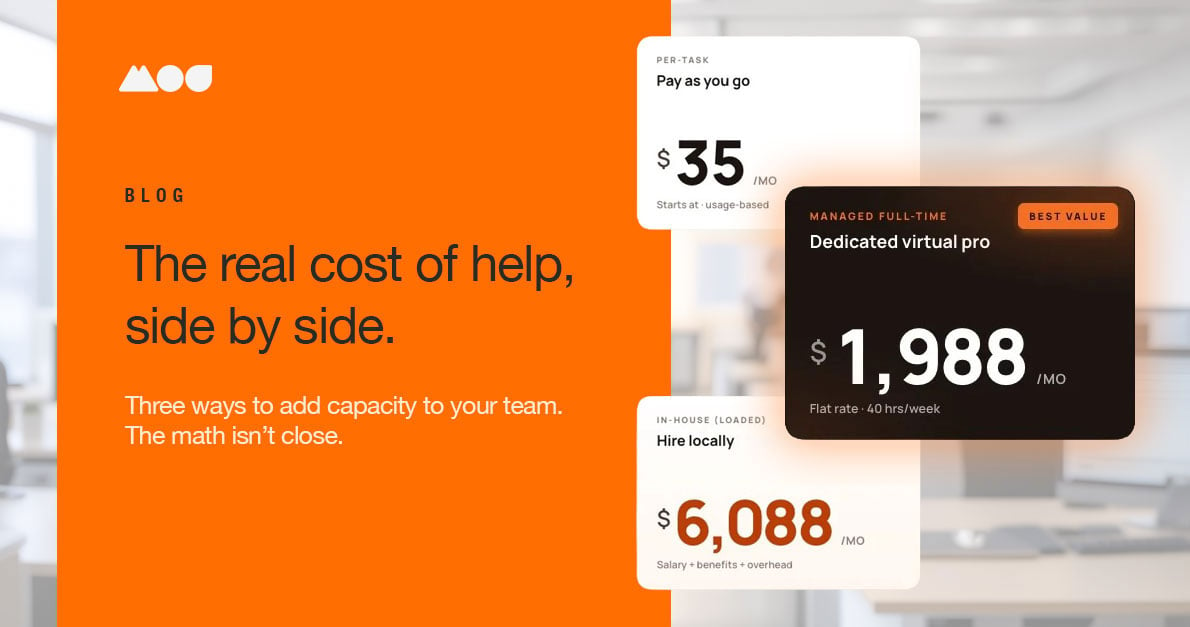
Virtual assistant cost in 2026 runs from $9 to $80 per hour, or about $35 a month for per-task plans up to $8,000 a month for a U.S. executive assistant. The most common pricing for a managed, full-time, dedicated virtual assistant lands between $1,988 and $3,000 per month for an offshore VA working U.S. business hours. The hourly rate is the easy number. The harder number is what you actually pay once a provider adds hour buckets, pod fees, partial-hour rounding, setup costs, and replacement charges, and how that compares to the fully loaded cost of doing the same work in-house.
This guide pulls current virtual assistant pricing from named provider pages, anchors the in-house cost comparison to U.S. Bureau of Labor Statistics data, and breaks down the four pricing models that VA providers actually use. By the end, you will know what a fair virtual assistant rate looks like for the role you are hiring, what questions to ask before signing, and how to model the in-house cost you are replacing.
Disclosure: this guide is from MyOutDesk. We sell full-time dedicated virtual assistants, and our price is named in the tables below alongside our competitors. The math holds up regardless of which provider you choose.
Table of contents
- How much does a virtual assistant cost? (short answer)
- How virtual assistant providers price
- Virtual assistant cost by role
- Experience level and pricing
- U.S. vs. offshore VA cost
- In-house cost comparison
- Service models compared
- How MyOutDesk prices
- Worked example: bucket vs. dedicated
- Virtual assistant cost trends for 2026
- Frequently asked questions
The short answer: what does a virtual assistant cost in 2026?
A virtual assistant costs between $9 and $80 per hour in 2026, with monthly retainers ranging from $35 for per-task plans to $8,000 for a U.S. executive assistant. The most common pricing for a managed, full-time, dedicated virtual assistant is $1,988 to $3,000 per month. Effective rate depends on whether you buy hours, tasks, shared pod coverage, or a full-time dedicated person.
| Pricing model | Typical entry price | Effective hourly rate | What you actually get |
|---|---|---|---|
| Per-request (e.g., Fancy Hands) | $35 / month | n/a (3 to 15 tasks) | Shared task pool, no dedicated person |
| Hour-bucket / fractional | $390 to $2,600 / month | $36 to $65 / hour | 10 to 60 hours of monthly assistant capacity |
| Offshore dedicated full-time | $1,500 to $3,000 / month | $9 to $19 / hour | One provider-managed offshore team member |
| Managed full-time dedicated (MyOutDesk) | $1,988 / month | ~$12 / hour | One full-time U.S.-managed VA with HR, payroll, oversight built in |
| In-house U.S. admin (loaded) | $6,088 / month | ~$35 / hour | One W-2 employee plus benefits, taxes, software, office |
Vendor pricing pages checked April 27, 2026; BLS Employer Costs for Employee Compensation, Q4 2025; BLS OOH, Secretaries and Administrative Assistants.
If you only read one section, read this one. The rest of the article shows where each number comes from and why a $390 plan can carry a much higher effective hourly rate than a $1,988 full-time plan once you do the math.
How virtual assistant providers actually price
Most buyers ask “what is the hourly rate?” The better question is “how is this priced?” Virtual assistant price changes a lot depending on whether you are buying requests, hours, shared coverage, or a dedicated full-time person. Below are the four models you will see, what each looks like in a quote, and the questions to ask before signing.
1. Hour-bucket plans
Hour-bucket plans sell you a block of hours per month: 10, 20, 40, 55, 80, or 160. The math looks clean, but you are buying a limited amount of monthly capacity, not necessarily a full work week from one person. Some providers assign a dedicated assistant; others use team coverage, overflow support, or shared request pools. Ask how many hours are reserved, who does the work, what happens during PTO, and how response times are handled.
A few real examples from current pricing pages:
- Time etc: $390 for 10 hours, $760 for 20, $1,480 for 40, $2,160 for 60. Effective rate $36 to $39 per hour.
- Boldly: $2,600 for 40 hours, scaling up to 100 hours, all at $65 per hour for general work, $79 for specialty.
- Delegated: $1,200 for 25 hours (Lite), $2,400 for 50, $3,600 for 75, with $60 per hour overage.
- Zirtual: $599 for 12 hours, $899 for 20, $1,199 for 30, $1,699 for 45. Effective rate around $50 per hour.
- Prialto: $1,500 per “unit” of 55 hours per month (around $27 per hour), with three units packaged at $3,600 for full-time coverage.
The trade-off: a 40-hour bucket may be right-sized for light admin, but it does not replace a full-time role. You get a defined amount of capacity and need to understand whether that capacity comes from one dedicated assistant, a backup team, or a shared support model. That distinction affects continuity, response time, and how quickly the assistant learns your business. We work the cost math against a full-time retainer in the worked example near the bottom of this guide.
2. Pod or shared-pool plans
Pod plans assign your work to a small team rather than one person. You submit tasks and the next available pod member picks them up. Magic’s “Magic 24/7” tier ($199 per week, 10 hours) and Fancy Hands request plans are pod-style.
The marketing pitch is “always covered, no PTO gaps.” The trade-off is continuity: no single person may know your business as deeply as a dedicated teammate. Pod models can work well for one-off lookups and simple recurring requests. They are a weaker fit for workflows that require deep context, tool familiarity, or judgment built over time. If continuity matters, the full-time dedicated model (covered next) is the better structural fit.
3. Per-request plans
Per-request plans (Fancy Hands at $35 for 3 requests, $55 for 5, $125 for 15) bill by discrete task instead of by time. They are useful for personal errands and one-shot research, but they are not built for business workflows where a single project may take hours and span multiple requests.
4. Full-time dedicated (monthly retainer)
Full-time dedicated assigns one person to your business for 8 hours a day, 5 days a week, and that person works exclusively for you. No bucket. No pod. No partial-hour rounding. Pricing is a flat monthly retainer.
This is how MyOutDesk prices. It is also how Athena ($3,000 per month for an executive assistant) and Wishup ($1,999 per month) structure their core offerings.
The key advantage: at 160 hours per month, $1,988 works out to $12.43 per hour, less than half the effective rate of many 40-hour bucket plans. You move from buying a slice of monthly capacity to building continuity with one person who learns your business.
Things To Note
- Partial-hour rounding. Some providers round every task up to the nearest 15 or 30 minutes. A 5-minute calendar fix becomes a 30-minute charge. Full-time monthly retainers (including ours) avoid this because billing is not per task.
- Setup or onboarding fees. Setup or onboarding fees. A one-time implementation, matching, or onboarding fee is standard across the category. Prialto, for example, charges $250 (waived on annual). If managed hardware is in your plan, please also take that into account.
- Overage rates. Hour-bucket plans charge premium rates for hours beyond your tier, typically $50 to $80 per hour. A dedicated full-time retainer has no overages because the assistant is yours for the full month.
- Annual minimums. Most providers now lock their best rates to a 6 or 12-month commitment because longer engagements produce better outcomes. The assistant has time to learn your business, build real context, and operate with judgment instead of just executing tasks. Worth knowing the term length you’re committing to so you can plan around it.
- “Specialty” upcharges. Some providers price specialty work such as marketing, bookkeeping, project management, or executive support differently from general admin. Ask any provider what role types or skills shift the price.
- Replacement fees. Ask whether rematching or replacing an assistant is included. At MyOutDesk, replacements are included at no extra cost.
Virtual assistant price by role: what help really costs
Hourly ranges shift by the kind of work being done and the experience of the person doing it. Here is the current range across role types in 2026, drawn from marketplace data and provider pricing pages.
| Role | Typical hourly range | Common monthly retainer | What’s included |
|---|---|---|---|
| General administrative | $15 to $30 | $1,500 to $2,500 | Email, calendar, data entry, travel, file management |
| Customer service | $15 to $30 | $1,800 to $2,800 | Inbound chat, email, phone, ticketing |
| Bookkeeping | $20 to $40 | $2,000 to $3,500 | AR/AP, reconciliation, payroll prep, reporting |
| Marketing | $20 to $50 | $2,200 to $4,000 | Social posting, email, content scheduling, basic design |
| Real estate | $20 to $40 | $1,988 to $3,200 | Listing input, transaction coordination, ISA, lead follow-up |
| Inside sales / SDR | $20 to $50 | $2,500 to $4,500 | Lead qualification, cold outreach, CRM hygiene |
| Healthcare admin | $20 to $40 | $2,500 to $3,500 | Scheduling, intake, eligibility, prior auth, HIPAA-trained |
| Executive support | $30 to $80 | $3,000 to $6,000 | Calendar, travel, board prep, project management |
| Specialty (legal, finance, technical) | $30 to $80 | $3,500 to $6,500 | Domain expertise, compliance-aware work |
Marketplace benchmarks: ZipRecruiter reports a U.S. average of $24.40 per hour for “virtual assistant,” with the 25th to 75th percentile at $42,500 to $57,000 per year. Indeed lists $25.60 per hour from 822 self-reported salaries (range $15.64 to $41.89). Glassdoor shows $25 per hour. Upwork lists $18 to $35 per hour as the typical range and $50 to $65 for U.S. and Canada specialists.
For a deeper breakdown of what each role does day to day, see our service pages on administrative virtual assistants, marketing virtual assistants, customer service virtual assistants, inside sales agents, bookkeeping virtual assistants, and transaction coordinators.
Experience level: when to pay more, when to save
A virtual assistant with 8 years of executive support experience is not the same hire as someone three months into the field. Three rules of thumb:
- Senior generalists (5+ years) typically command $15 to $25 per hour or $2,500 to $4,000 per month full-time. Worth it for executive support, complex calendars, sensitive communications, board prep, and any role where one expensive mistake costs more than a year of salary.
- Mid-level (2 to 5 years) typically run $12 to $19 per hour or $2,000 to $3,000 per month. The sweet spot for most operational roles: customer service, bookkeeping, transaction coordination, sales support.
- Entry-level (under 2 years) typically run $9 to $14 per hour or $1,500 to $2,200 per month. Good for high-volume, well-documented work where you have SOPs and management capacity.
The honest answer to “when do I pay more and when do I save?” is that most clients don’t know until they spell out what the role actually involves. The same role can fit an entry-level VA at $1,500 a month or a senior generalist at $4,000 depending on how much judgment, autonomy, and unsupervised decision-making the work actually requires. Pay too low and you spend your own time correcting mistakes. Pay too high and you burn budget on capability you never tap.
This is exactly what the free MyOutDesk strategy session is built to figure out. We walk through your actual workload with you, build the job description, and commit to matching you with a VA at the experience level you genuinely need (not just the tier that sounds impressive on paper).
If you’ve already got the job description and duties mapped, the rule is simpler than it sounds:
- Go senior when the role makes judgment calls on money, communicates with clients or executives without your sign-off, touches sensitive or compliance-bound information, or any single mistake would cost more than the senior premium does in a year.
- Go mid-level when the work is operational and recurring, the success criteria are obvious from the outside, and you want someone who runs it without daily oversight after the first few weeks.
- Go entry-level when the role is fully documented with SOPs already written, the output is easy to spot-check, and you have a manager with weekly review time built in.
Location: U.S.-based vs offshore
Geography is the single biggest lever on hourly rate. The same role costs three to five times as much in San Francisco as in Manila, Peru, or Morocco. The trade is real but smaller than buyers expect when the offshore VA is hired through a managed provider.
| Location | Typical full-time monthly | Effective hourly | Trade-offs |
|---|---|---|---|
| Philippines (managed) | $1,988 to $3,000 | $12 to $19 | English-fluent, U.S.-business hours, lower hourly cost. Cultural alignment depends on provider. |
| LATAM (managed) | $2,500 to $4,000 | $16 to $25 | Native or near-native English, U.S. time zones, growing bilingual Spanish capacity. |
| Eastern Europe | $3,000 to $5,000 | $19 to $31 | Strong technical skills, GMT alignment for European clients. |
| United States | $4,000 to $8,000+ | $25 to $50 | Native English, time-zone match, higher rate. Often hired direct, not through agencies. |
| United Kingdom / Australia | $4,500 to $7,500 | $28 to $47 | Same-language markets, premium rate. |
Bilingual demand keeps growing. We outlined the Spanish-speaking talent case in Why Top U.S. Businesses Are Hiring Spanish-Speaking Talent From Latin America, and broke down the Philippines specifically in Outsourcing To The Philippines: Pros, Cons & More and Virtual Assistants: Philippines vs. US.
What an in-house equivalent really costs (the comparison nobody shows)
The number a VA replaces is not “the hourly wage of an admin.” It is the fully loaded cost of a W-2 employee. The U.S. Bureau of Labor Statistics tracks this directly.
BLS occupational wages (May 2024 data, latest available)
| Role | BLS code | Median annual | Median hourly |
|---|---|---|---|
| Secretaries and Administrative Assistants | 43-6014 | $47,460 | $22.82 |
| Executive Secretaries and Executive Administrative Assistants | 43-6011 | $74,260 | ~$35.70* |
| Customer Service Representatives | 43-4051 | $42,830 | $20.59 |
| Bookkeeping, Accounting, and Auditing Clerks | 43-3031 | $49,210 | $23.66 |
BLS OOH publishes the 43-6011 annual median in this table; hourly estimate is annual pay divided by 2,080 work hours.
What benefits and overhead add
Wages are not the full bill. The BLS Employer Costs for Employee Compensation report (Q4 2025) shows that for private-industry workers, total compensation cost averages $46.15 per hour, with benefits making up 29.9 percent of total compensation. In dollar terms, wages run $32.36 per hour and benefits add another $13.79 per hour.
Translation: when an in-house admin’s posted salary is $47,460, the real cost to the employer is closer to $61,700 per year before you add software, equipment, office, and recruiting costs.
The full in-house cost stack
| Cost line | Annual | Monthly |
|---|---|---|
| Base salary (BLS median admin) | $47,460 | $3,955 |
| Benefits and payroll taxes (29.9%) | $14,191 | $1,183 |
| Workstation, software, phone | $2,400 | $200 |
| Recruiting and onboarding (amortized) | $3,000 | $250 |
| Office space allocation | $4,200 | $350 |
| Management overhead | $1,800 | $150 |
| Total fully loaded | $73,051 | $6,088 |
A $1,988-per-month MyOutDesk hire replaces $6,088 in monthly cost. That is a $4,100 monthly delta, or about $49,000 per year, on a single role. Run the math for two roles and the savings cover a senior hire. We have a step-by-step calculator that uses your role, state, and official BLS data that you can get here – it will grab actual data from the BLS, combine it with your role, and generate you a full breakdown of your actual costs.
Service models, reframed
Earlier guides on this topic (including ours) split the market into “freelance, managed, agency.” That framing hides the real difference, which is whether you are buying a person or buying capacity. Use this instead:
| Model | What you buy | Who manages | When it fits |
|---|---|---|---|
| Freelance marketplace (Upwork, Fiverr) | A person you find, vet, and manage | You | One-off projects, niche skills, low-volume |
| Hour-bucket agency (Time etc, Boldly, Delegated, Zirtual) | Limited monthly assistant capacity | The agency | 10 to 60 hours per month of light admin |
| Pod / per-request (Fancy Hands, Magic) | Tasks completed | The agency | One-shot errands, no ongoing context required |
| Full-time dedicated managed (MyOutDesk, Athena, Belay) | A full-time employee, fully managed | The agency | 30+ hours per week, ongoing role, business-critical work |
If you are tracking weekly to-dos that take 10 hours and never grow, an hour bucket is right-sized. If you are filling a role, a managed full-time hire is what you actually need, and the math works out cheaper per hour from day one.
For more on this distinction, see Managed or Unmanaged Virtual Assistants: Which Is Right For You? and Freelancer vs. Virtual Assistant.
How MyOutDesk prices
MyOutDesk has spent over a decade running one model: full-time dedicated, billed monthly, everything included.
- Managed Outsourcing: $1,988 / month for a full-time, college-educated VA from the top 0.7 percent of applicants. 8 hours a day, 5 days a week, working only for you. Recruiting, vetting, payroll, HR, benefits, onboarding, time tracking, and a dedicated account manager are built in.
- Specialized Outsourcing: $2,500 / month for industry-specific roles in healthcare, real estate, finance, or other regulated sectors. We do pre-vetting for you, you sign off on the final candidates.
- Custom Recruitment: quoted for unique roles, multi-candidate shortlists, or full team builds.
What we do not do: hour buckets, pods, partial-hour rounding, surprise overage fees, or “shared” labor pools. If a fit is not right, we rematch at no extra cost.
Compare the full feature breakdown on the pricing page, or run your own numbers using the cost savings calculator (it pulls BLS data for your state and role and returns a personalized savings report).
Worked example: $1,988 vs. a $390 hour bucket
A common comparison buyers run wrong: “$390 a month at Time etc. is way cheaper than $1,988 at MyOutDesk.” On a sticker basis, yes. On a per-hour basis:
- Time etc. 10-hour bucket at $390 = $39 per hour, 10 hours per month
- MyOutDesk Managed at $1,988 = $12.43 per hour, 160 hours per month
If the work fits in 10 hours per month and stays there, the bucket is fine. If the work grows to 30 hours per month (still part-time), Time etc.’s 40-hour bucket runs $1,480 ($37 per hour). MyOutDesk delivers the same 30 hours plus about another 130 available hours for $1,988. The break-even point against Time etc.’s 40-hour rate is about 54 hours of monthly work.
Most operational roles cross that line in their first month.
Virtual assistant cost trends for 2026
Three external data points worth knowing as you plan your 2026 budget:
- The Deloitte 2024 Global Outsourcing Survey found 83 percent of respondents now leverage AI in outsourced services. Companies are outsourcing for technology-enabled capacity, talent, and agility, not just for cheaper labor.
- Grand View Research values the AI-powered intelligent virtual assistant market at $3.07 billion in 2023 and projects it to reach $14.10 billion by 2030, a 24.3 percent CAGR. That is not the same market as human VA staffing, but it shows why buyers increasingly expect assistants to work with automation and AI tools.
- Sage’s 2025 small-business research found SMBs lose 24 days per year to financial admin alone. The point of a VA is not only to save labor cost. It is to give those hours back to the owner.
The pattern across all three: management quality, transparent pricing, and integrated tooling matter more than the cheapest hourly headline number. That is the bet behind how we price.
For more numbers like these, see 25 Virtual Assistant Statistics To Help Scale Your Business Faster In 2026.
Frequently asked questions
How much does a virtual assistant cost per month?
A virtual assistant costs between $35 and $8,000 per month in 2026, depending on pricing model. Per-task plans (Fancy Hands) start at $35 per month. Hour-bucket plans run $390 to $2,600 per month for 10 to 60 hours of capacity. Managed full-time dedicated VAs from offshore providers run $1,988 to $3,000 per month for 160 hours. U.S.-based full-time VAs run $4,000 to $8,000 per month. The most common monthly cost for a small business hiring a managed, full-time VA is $1,988 to $2,500.
What is the average hourly rate for a virtual assistant?
The average hourly rate for a virtual assistant is $24 to $26 in the U.S., per ZipRecruiter, Indeed, and Glassdoor. Effective hourly rates by pricing model are: hour-bucket plans $36 to $65 per hour, offshore dedicated full-time $9 to $19 per hour, U.S. specialists $50 to $65 per hour, and managed full-time dedicated VAs about $12 per hour at 160 hours per month.
Are virtual assistants really cheaper than in-house employees?
Yes, and the gap is bigger than most buyers calculate. The typical mistake is comparing a VA’s hourly rate to an in-house employee’s posted salary. The right comparison is the VA’s all-in monthly cost to the in-house employee’s fully loaded cost (wages plus 29.9 percent benefits per BLS ECEC, plus software, office, recruiting, and management overhead). On a $47,460 admin salary, the fully loaded cost is around $73,000 per year. A managed full-time VA at $1,988 per month runs $23,856 per year. The savings are typically 60 to 70 percent. See Virtual Assistant vs. Employee for the full breakdown.
How much can a small business actually save?
For one role, $40,000 to $50,000 per year is typical when replacing or avoiding an in-house hire. For two roles, it lands closer to $80,000 to $100,000. Run your specific numbers in our savings calculator.
Why are MyOutDesk’s full-time VAs cheaper per hour than a 10-hour bucket plan?
Because hour-bucket plans price limited monthly capacity. A 10-hour plan can be useful, but its effective hourly rate is much higher than a full-time dedicated retainer. A full-time dedicated VA spreads the same fixed monthly management layer across 160 hours. One person, one client, one rate.
Are full-time virtual assistants really full-time?
For some providers, yes. For others, “full-time” may describe monthly capacity rather than exclusive assignment. Confirm three things in any quote: (1) the assistant works only for you, (2) you have visibility into their daily hours via time tracking, and (3) the contract specifies the assistant’s hours per day, not just hours per month. MyOutDesk publishes time data via MyTimeIn for every hire.
What about partial hours, pods, and “buckets” in the fine print?
Watch for these specifically: rounding language (“billed in 15-minute increments”), bucket overage rates, “shared talent pool” or “team-based” descriptions, and any line item separating “specialty” hours from “general” hours. Each one is a place the effective rate climbs above the headline rate. Ask the salesperson to model your typical month at full utilization and again at 30 percent overage. If the second number is more than 1.3x the first, the pricing is bucket-driven. MyOutDesk’s full-time retainer model sidesteps all four because the assistant is yours for the month, not billed per task or per hour bracket.
How do U.S.-based and offshore VAs really compare on cost?
A U.S.-based VA hired direct typically runs $4,000 to $8,000 per month full-time. A managed Philippines or LATAM full-time VA runs $1,988 to $3,000 per month. The practical differences are provider vetting, training, management quality, time-zone preference, accent preference for phone-heavy roles, and any work that requires legal U.S. work authorization or specific compliance controls.
What does it cost to hire a virtual receptionist specifically?
Virtual receptionists are priced differently from general VAs because they are often billed per call or per minute. Typical ranges run $1.20 to $2.50 per minute or $200 to $1,500 per month for capped plans. We covered this in How Much Does a Virtual Receptionist Cost?.
How do I pay a virtual assistant?
If you go through a managed provider, you pay one monthly invoice and the provider handles the assistant’s payroll, taxes, benefits, and equipment. If you hire freelance via Upwork, Fiverr, or directly, you pay per invoice or via a marketplace’s escrow, and you are responsible for your own 1099 reporting. The managed model removes payroll, contractor admin, and tax-filing complexity. At MyOutDesk, that single monthly invoice covers payroll, taxes, benefits, equipment, time tracking via MyTimeIn, and a dedicated account manager. We compare the workflow side of this in Fiverr vs. Upwork.
How long does it take to ramp a virtual assistant?
For a well-documented role with SOPs ready, expect productive output in week one and full speed by week three. For roles where you are still building the SOPs, plan four to six weeks of co-piloting. Managed providers typically include onboarding support and a 90-day launch plan. We outline a starting framework in How To Hire a Virtual Assistant: The Complete 2026 Guide.
What if the fit is not right?
A managed provider should rematch at no extra cost. An hour-bucket agency may charge a setup or transition fee. A direct-hire freelancer means starting the search over. Confirm the rematch policy in writing before signing.
Summary: what should a virtual assistant cost you?
A virtual assistant’s hourly rate is the headline number, not the answer. The total cost depends on which pricing model you signed: per-request ($35 a month and up), hour-bucket ($390 to $2,600 a month for 10 to 60 hours), pod (shared coverage), or full-time dedicated ($1,988 to $3,000 a month for 160 hours). The cost you are comparing against is not an in-house admin’s posted salary, it is the fully loaded $73,000-per-year stack that BLS data documents.
For most operational, sales, and customer-facing roles that need ongoing context, a full-time dedicated virtual assistant in the $1,988 to $3,000 per month range delivers the best combination of effective hourly rate, continuity, and oversight. For one-off projects under 10 hours per month, an hour bucket or per-request plan is fine.
Next step: model your specific savings with the MyOutDesk Cost Savings Report (it pulls BLS data for your state and role), or book a strategy call and we will run the numbers with you and show you exactly which pricing model fits your situation.
About The Author

Steve Young is a marketing executive with 20 years of experience across B2B SaaS, outsourcing, HR tech, fintech, cybersecurity, and consumer electronics. He specializes in performance marketing, GTM strategy, and revenue operations, with a track record of building programs from the ground up and scaling them globally across North America, EMEA, and APAC. He currently leads demand gen at MyOutDesk.
Related Posts
-
 Hiring, Virtual Assistants
How Much Does an HR Virtual Assistant Cost in 2026? (Complete Pricing Guide for Small Businesses)
Outsourcing HR can save a small business 40–70% compared to hiring a full-time in-house HR manager, whose average total compensation exceeds $153,875/year (salary plus benefits and overhead).
Read more -
 Hiring
25 Virtual Assistant Statistics To Help Scale Your Business Faster In 2026
Discover the most important virtual assistant statistics for 2026, from cost savings and productivity gains to how modern businesses are scaling with remote talent.
Read more -
 Hiring
How To Hire a Virtual Assistant: The Complete 2026 Guide
Unlocking the benefits of hiring a virtual assistant can transform your business. From cutting costs to boosting productivity and enhancing flexibility, a skilled virtual assistant is a game-changer for achieving your goals. Ready to make the leap? If you’ve decided that a virtual assistant is the right solution to elevate your business, it’s time to focus on making your first hire a resounding success. The key? Hiring the right virtual assistant for your needs.
Read more -
 Hiring
Blended Business Model: Integrating Remote Workers, Virtual Assistants & In-Office Staff
The modern workforce is blended—uniting in-office staff, remote employees, and virtual assistants into one high-performing team. Learn why more companies are adopting this model, common pitfalls to avoid, and how to implement it successfully.
Read more -
 Hiring
The 6 Best Real Estate Virtual Assistant Companies – 2026 Update
Enhance your business with insights highlighting the best real estate virtual assistant companies. Discover tailored solutions to streamline operations, optimize client interactions, and drive success in the competitive real estate market.
Read more -
 Hiring, Virtual Assistants
Top Tools for Measuring Employee Satisfaction in 2026
These are the most effective employee satisfaction measurement tools that help organizations understand how their teams feel and identify areas for improvement.
Read more -
 Hiring
8 Best Virtual Assistant Companies of 2026
Explore the best virtual assistant companies expertly curated by MyOutDesk. We’ll help you find top virtual assistance solutions that cater to your business needs, enhancing productivity, fostering scalability and streamlining operations.
Read more -
 Healthcare, Hiring, Virtual Assistants
Executive Insights: Solving The Healthcare Talent Shortage with Virtual Teams
The healthcare industry in the United States is grappling with a severe talent shortage that threatens the quality and accessibility of patient care. According to the Association of American Medical Colleges (AAMC), the US could face a deficit of approximately 139,000 doctors by 2033. Additionally, the US Department of Health and Human Services reports that … Read more
Read more -
 Hiring
Outsourcing To The Philippines: Pros, Cons & More
The Philippines is one of the top destinations where major corporations outsource their business needs too, allowing businesses to keep overhead down on expenses such as office space, equipment, internet connection, taxes, and even benefits.
Read more -
 Hiring
The 5 Best Virtual Receptionist Services of 2026
Discover 5 leading virtual receptionist service options in MyOutDesk’s comprehensive guide. Explore how these services can revolutionize your business communication, providing efficiency and professionalism for unparalleled customer interactions.
Read more -
 Hiring
Fiverr vs. Upwork: Comparing Workflow, Cost, and Freelance Talent For Your Business
Unsure about Fiverr vs. Upwork? MyOutDesk’s blog delves into the comparison, offering insights to help you choose the right freelance platform for your projects. Make informed decisions and maximize your freelancing opportunities with this comprehensive guide.
Read more -
 Hiring
The 8 Best Upwork Alternatives of 2026
Exploring options beyond Upwork? MyOutDesk’s blog offers valuable insights into the 8 best Upwork alternatives. Find tailored platforms with solutions to suit your business needs and achieve new levels of growth and success.
Read more