
If you’re frustrated with Upwork’s rising Connects costs, unpredictable service fees, or time-consuming vetting process, you’re not alone. In 2025, Upwork’s active client base fell from 832,000 to 785,000—a 6% contraction—as companies and freelancers alike sought better options.
This guide breaks down eight powerful Upwork alternatives, comparing their fee structures, talent quality, and hidden costs—so you can find the right fit for your business or freelance career.
These alternatives were chosen as they better reflect the freelance landscape of 2026, with actionable, data-backed recommendations.
Instead of listing marketplaces at a high level, it compares who each platform works best for, what the real trade-offs look like, and how pricing, vetting, speed, and platform rules can affect both hiring outcomes and freelancer earnings.
Finding the best Upwork alternatives is essential for scaling your business or freelance career. Whether you’re looking for sites like Upwork for freelancers to find steady work or the best freelance platforms for hiring remote talent—this guide covers the top choices. We also highlight cheaper alternatives to Upwork to help you maximize your budget.
TL;DR — Best Upwork Alternatives at a Glance
Top picks for 2026:
- MyOutDesk – pre-vetted, managed, and dedicated VAs
- Toptal – elite freelancers
- Fiverr – gig projects
- Freelancer.com – global bidding
- Guru – low fees)
- PeoplePerHour – UK/EU focus
- Contra – 0% commission
- FlexJobs – verified remote jobs
Choose MyOutDesk for full‑service virtual assistants, Toptal for top‑tier developers, Contra to avoid fees, and FlexJobs for scam‑free listings. Avoid Upwork’s rising Connects costs and variable 0–15% fees by matching your project type to one of these eight alternatives.
What’s Inside
- Why Look Beyond Upwork in 2026?
- How We Evaluated The Best Upwork Alternatives
- Top 8 Upwork Alternatives
3.1. MyOutDesk – Best for Dedicated Virtual Assistants
3.2. Toptal – Best for Elite Freelancers
3.3. Fiverr – Best for Gig‑Based Projects
3.4. Freelancer.com – Best for Competitive Bidding
3.5. Guru – Best for Structured Collaboration
3.6. PeoplePerHour – Best for UK/EU Creative Talent
3.7. Contra – Best for Zero‑Commission Freelancing
3.8 FlexJobs – Best for Remote Professional Freelancers - Head‑to‑Head Comparison Table
- Which Upwork Alternative Is Right for You?
- Frequently Asked Questions (FAQs)
- The Bottom Line: Which Upwork Alternative Should You Choose?
Why Look Beyond Upwork in 2026?
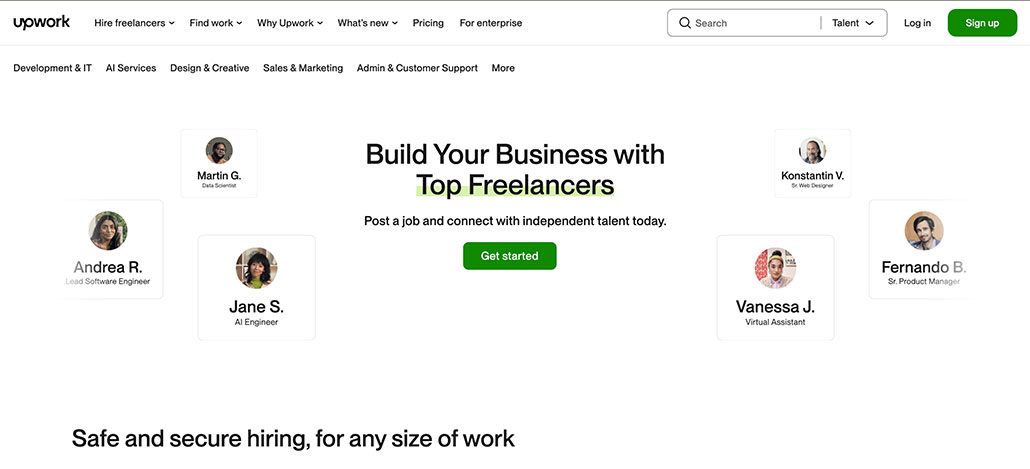
Upwork remains the largest freelance marketplace, processing over $4 billion in annual gross services volume (GSV). However, several shifts in 2025–2026 have made alternatives increasingly attractive:
- Fee volatility: On May 1, 2025, Upwork replaced its flat 10% freelancer fee with a variable 0%–15% per-contract fee, determined by an undisclosed algorithm. Many freelancers now pay 10–13% on standard contracts, and commodity categories (like basic virtual assistance) face the highest rates.
- Hidden costs: When you factor in paid Connects ($0.15 each), contract initiation fees, and wasted proposal labor, the true effective cost for agencies often reaches 22–34% of gross contract revenue. This financial strain is worsened by Upwork’s hyper-competitive “pay-to-play” bidding system. High-earning, established creators can aggressively spend Connects to boost their proposals and profiles to the top of client feeds. This creates an uneven marketplace where organic visibility is buried, forcing clients to either pay top dollar for heavily advertised talent or take a risk on unboosted, less-tested freelancers.
- Shrinking buyer pool: Despite Upwork’s framing of “low-value client rationalization,” the number of active clients dropped 6% year-over-year, intensifying competition.
- Quality and management overhead: Many businesses report that freelancer quality is inconsistent, with developers disappearing mid-project and management consuming 10–20 hours per week.
These challenges explain why 63% of independent service providers now use online talent platforms, up from just 37% in 2020, according to MBO Partners 2025 State of Independence. And the freelance platform market is projected to grow from $6.3 billion in 2025 to over $12 billion by 2030, indicating strong demand for alternatives.
How We Evaluated the Best Upwork Alternatives
To make this comparison more useful for both hiring companies and freelancers, we evaluated each platform across the factors that most often shape success: pricing transparency, freelancer or client fees, quality control, speed to hire, support for long-term work, strength in a specific niche, and the amount of management overhead required after the hire.
This matters because the “best” Upwork alternative is rarely the cheapest one.
In practice, the right fit depends on whether you value speed, elite talent, lower fees, geographic specialization, or a safer hiring experience with stronger screening and support.
Specifically, we looked at these:
- Cost structure: not just headline fees, but subscriptions, bidding costs, minimum fees, and buyer-side charges that affect pricing power.
- Talent quality and vetting: whether the platform is open, curated, managed, or heavily screened.
- Best use case: one-off tasks, ongoing support, premium technical hiring, regional hiring, or portfolio-led discovery.
- Operational burden: how much sourcing, interviewing, onboarding, and supervision the client or freelancer must handle.
- Trust and reliability: escrow, dispute handling, reviews, reputation, and safeguards against scams or churn.
- Long-term fit: whether the platform helps build durable relationships or is optimized mainly for quick transactions.
Top 8 Upwork Alternatives
So, here are our top eight Upwork alternatives:
1. MyOutDesk – Best for Dedicated Virtual Assistants
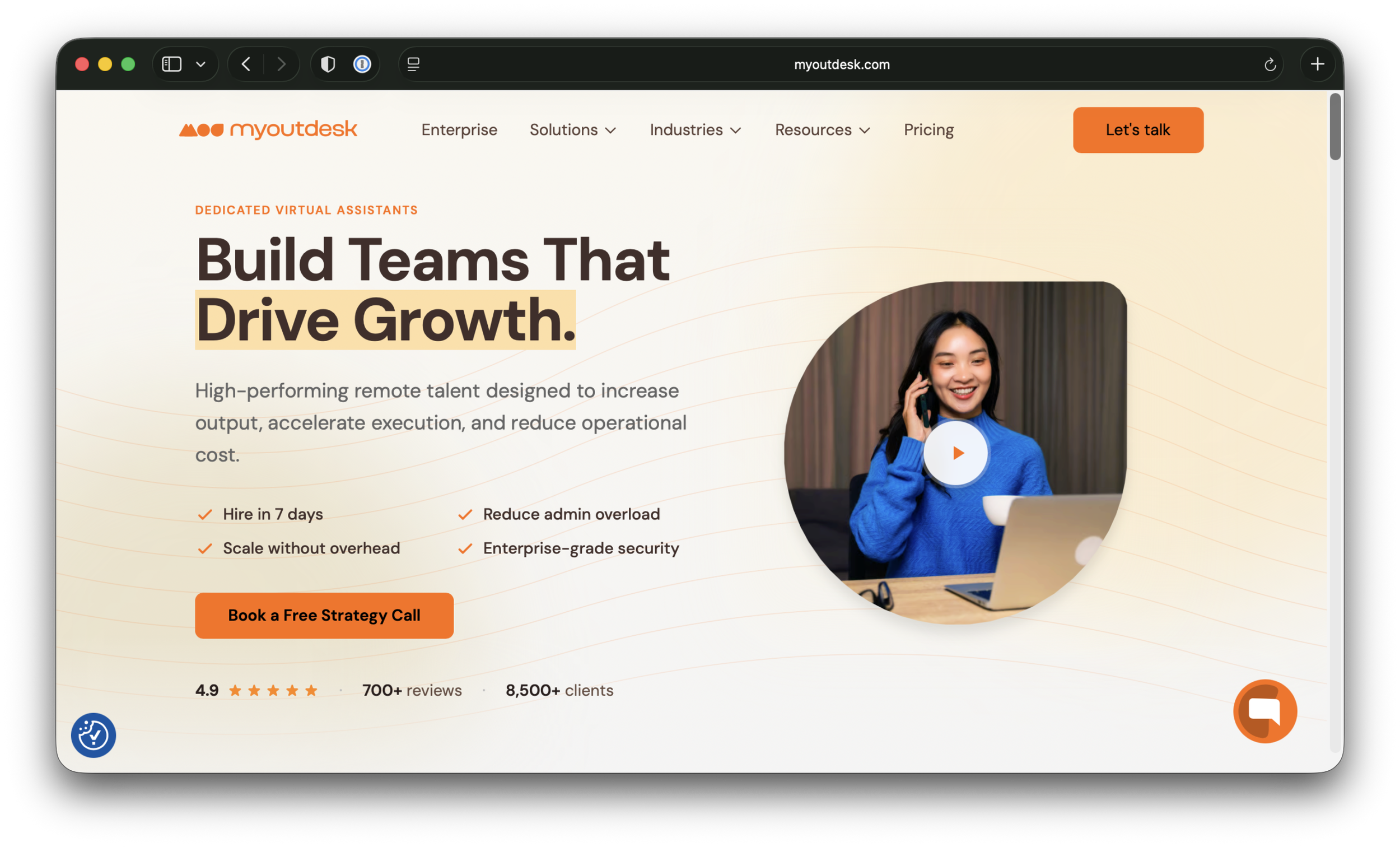
MyOutDesk is a leading virtual assistant company specializing in providing highly vetted (only the top 0.7% of applicants get in) dedicated virtual assistants for businesses of all sizes. Unlike self-service marketplaces, MyOutDesk handles rigorous screening, training, and ongoing management.
- Pricing: Custom monthly plans based on assistant tier and hours.
- Key advantage: Dedicated assistants, thorough vetting, and proprietary MyTimeIn software for full transparency and control.
- Best for: Businesses that need recurring help with operations, customer support, lead follow-up, admin work, or appointment setting.
- Not ideal for: Buyers who only need a quick one-off design, development, or writing task.
- Watch-outs: Because it is more managed than a self-serve marketplace, it may not be the cheapest option on paper. But for companies that value reliability and lower supervision, the total cost of ownership may be more favorable than a lower-fee platform that consumes internal management time.
Why it stands out: MyOutDesk is a strong alternative to Upwork for companies that are not just looking for a freelancer marketplace but for a more managed talent solution. This distinction is important.
On Upwork, clients often spend significant time writing job posts, screening applicants, testing candidates, and managing performance. MyOutDesk reduces this operational load by emphasizing dedicated, pre-vetted assistants and ongoing accountability.
For busy founders, real estate teams, healthcare practices, and service businesses, this can translate into faster time-to-productivity and less hiring friction.
2. Toptal – Best for Elite Freelancers
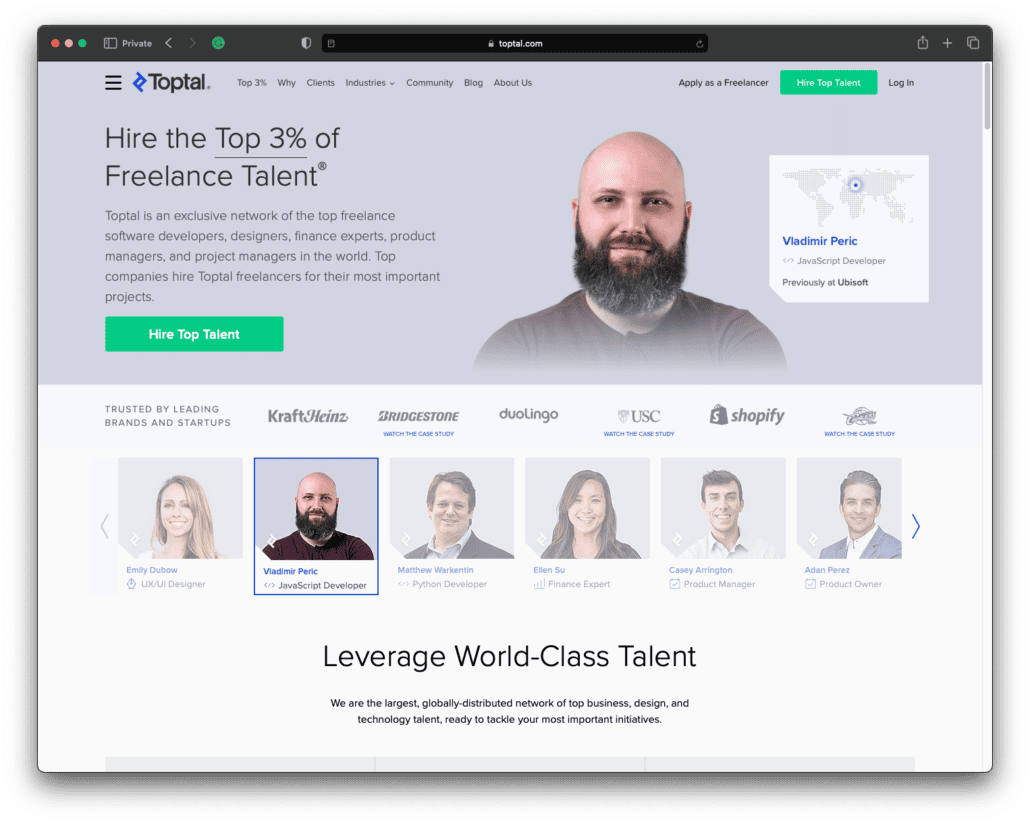
Toptal built its reputation on accepting only the top 3% of freelancer applicants through a multi-stage vetting process. It’s the go-to choice for companies burned by quality inconsistencies on generalist platforms.
- Pricing: $100–200+ per hour. No platform fee for clients; freelancers keep 100% of their rate.
- Key advantage: Rigorous vetting, flexible engagements (hourly/part‑time/full‑time), and a no‑risk trial period.
- Best for: High‑stakes technical roles, specific well‑defined projects, and teams with project management capacity. Senior engineering, product, design, finance, and consulting work where expertise is mission-critical.
- Not ideal for: Price-sensitive businesses, small experiments, or highly repetitive tasks.
- Watch-outs: Premium hourly rates and a less self-service hiring flow mean Toptal works best when the project is clearly defined and the budget can absorb top-tier talent.
- Consideration: Premium pricing and a hiring process that can take 1–3 weeks.
Why it stands out: Toptal is one of the strongest alternatives to Upwork when project quality matters more than budget flexibility. Its value proposition is not breadth; it is selectivity.
This makes the platform ideal for companies looking for the best Upwork alternatives for developers or seeking the freelance site with the best vetted talent.
If the cost of a bad hire is high—missed deadlines, security concerns, architecture mistakes, or failed product launches—then a curated network can justify the premium.
3. Fiverr — Best for Gig‑Based Projects
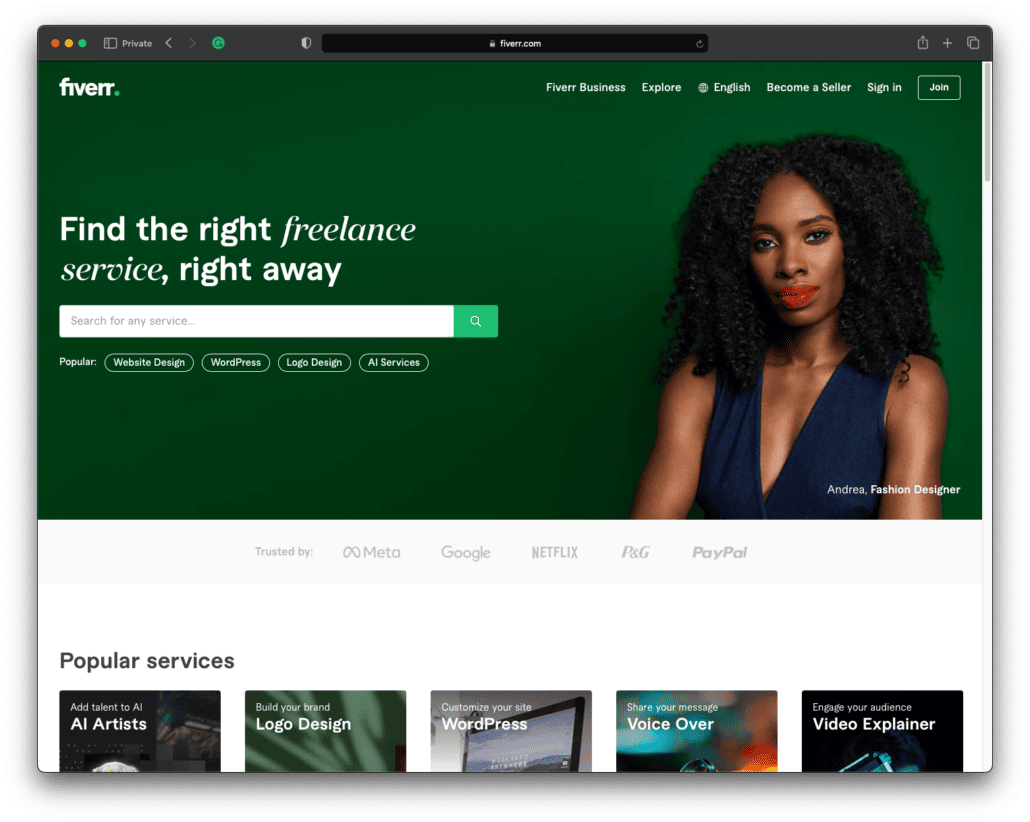
Fiverr pioneered the “gig” model, where freelancers post fixed‑price service packages (gigs) starting at $5. Clients browse and purchase directly, bypassing the bidding process.
- Pricing: Service fees of 5.5% on purchases up to $50 and 5% on purchases over $50 for clients; freelancers pay 20% commission on gig earnings.
- Key advantage: Fast, friction‑free hiring for creative, digital, and micro tasks.
- Best for: One‑off projects, small creative tasks, and businesses needing quick turnaround for projects such as logos, thumbnails, short‑form video edits, social assets, voiceovers, simple copy tasks, and repeatable creative deliverables.
- Not ideal for: Complex collaboration-heavy projects that evolve over weeks or months.
- Watch-outs: The convenience is real, but quality can vary widely across sellers, and scope creep can turn a cheap gig into a fragmented buying experience if the brief is not precise.
Why it stands out: Fiverr is the best-known Upwork alternative for productized, fast-turnaround services. Instead of posting a project and waiting for proposals, the buyer browses predefined offers and buys directly.
Fiverr is ideal for businesses needing a reliable Upwork alternative for logo design, quick freelance help, or a way to hire a freelancer without bidding. The buying experience is simpler, which reduces friction for straightforward work.
4. Freelancer.com – Best for Competitive Bidding
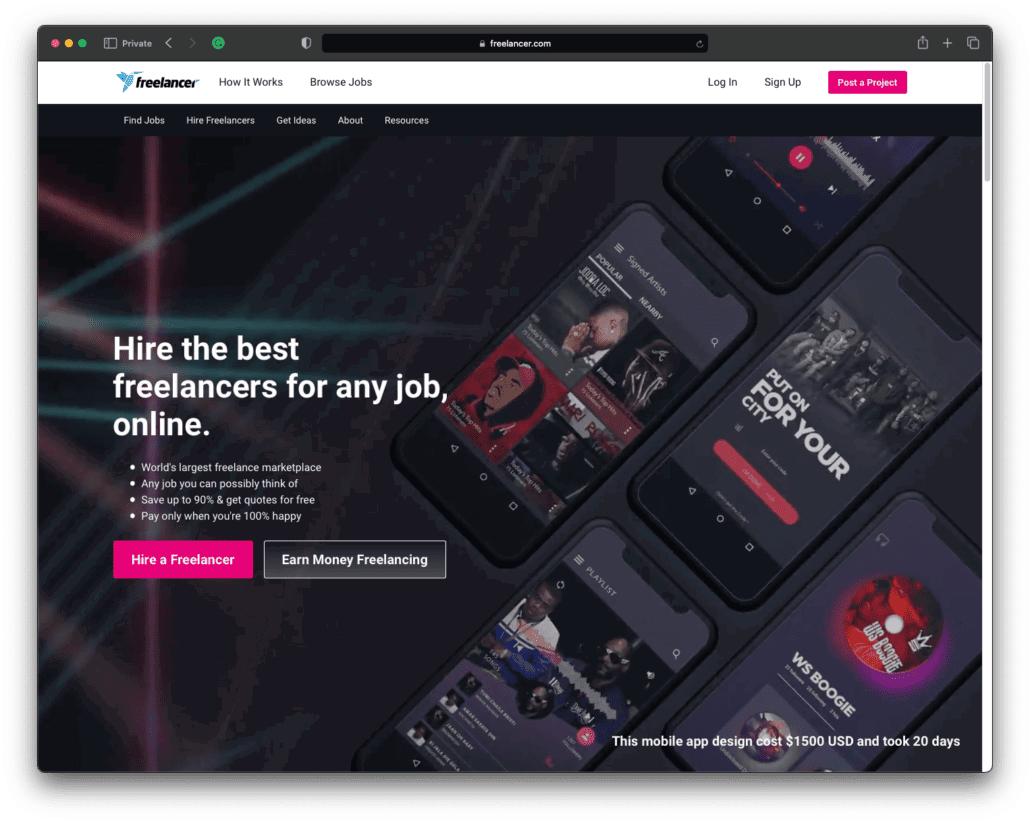
Freelancer.com claims over 86 million registered users across 2,700+ skill categories, making it the largest freelance marketplace by user count. It uses a competitive bidding model and even offers creative contests where multiple freelancers submit work, with only the winner paid.
- Pricing: Freelancer service fee of 10% (or $5 minimum per project); client fee of 3% (or $3 minimum).
- Key advantage: Massive global talent pool, 34 languages supported, and a unique contest model for creative work.
- Best for: Businesses needing competitive pricing or seeking highly specialized niche talent. Businesses with cost-conscious hiring, broad international sourcing, and creative contests.
- Not ideal for: Teams that want heavy vetting or minimal applicant noise.
- Watch-outs: Competitive bidding can drive down prices, but it also increases the amount of screening required to separate strong specialists from generic proposals.
Why it stands out: Freelancer.com remains relevant because of scale and price competition.
If your main objective is access to a very large international freelancer pool, it can surface options quickly across many categories.
The contest model is also distinctive for certain creative use cases where buyers want to compare multiple approaches before choosing a winner. For some clients, this feels more tangible than reviewing portfolios alone.
5. Guru – Best for Structured Collaboration
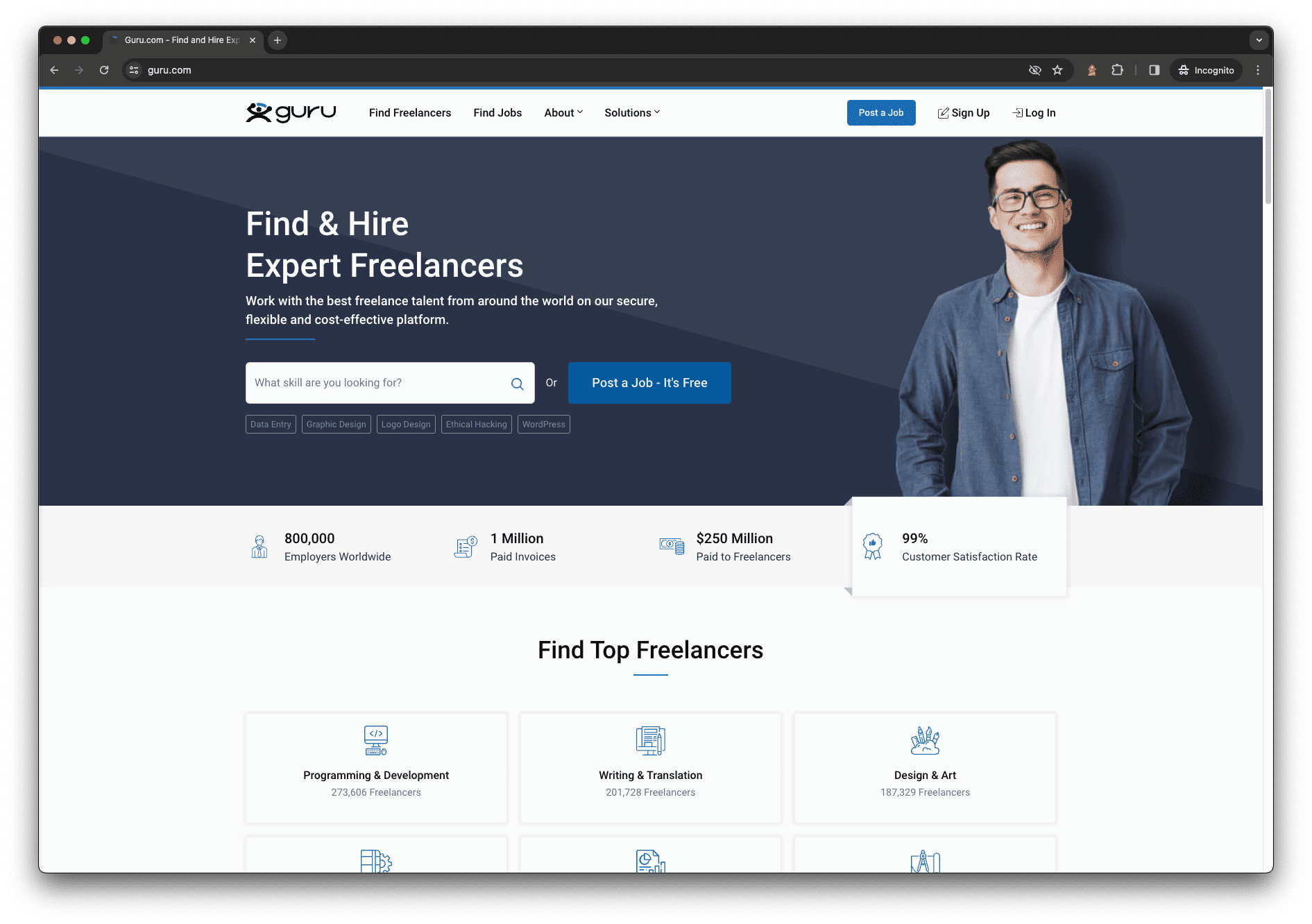
Guru emphasizes structured collaboration, offering a workroom with files, milestones, and payment tracking. It has lower platform fees than many competitors and supports both fixed‑price and recurring work.
- Pricing: Freelancers choose a membership tier from free (with 5% service fee) to $21.95/month (with 0% fee). Clients pay 2.9% of the transaction amount.
- Key advantage: Lower fee structure, transparent workroom, and strong support for long-term relationships.
- Best for: Businesses seeking affordable, structured collaboration with freelancers. Businesses with ongoing contractor relationships, milestone-based work, and buyers who want lower marketplace friction without giving up basic project controls.
- Not ideal for: Those seeking either ultra-premium curated talent or ultra-fast productized gigs.
- Watch-outs: As with other open marketplaces, outcomes still depend heavily on the quality of the brief and the diligence of the hiring manager.
Why it stands out: Guru stands out as a highly effective Upwork alternative by filling an important middle ground. The platform offers lower fees than many large marketplaces, support for recurring work, and a collaboration environment that feels more structured than a pure gig board.
For businesses that already know how to work with freelancers and want a steadier, less chaotic environment, Guru can be a practical choice.
6. PeoplePerHour – Best for UK/EU Creative Talent
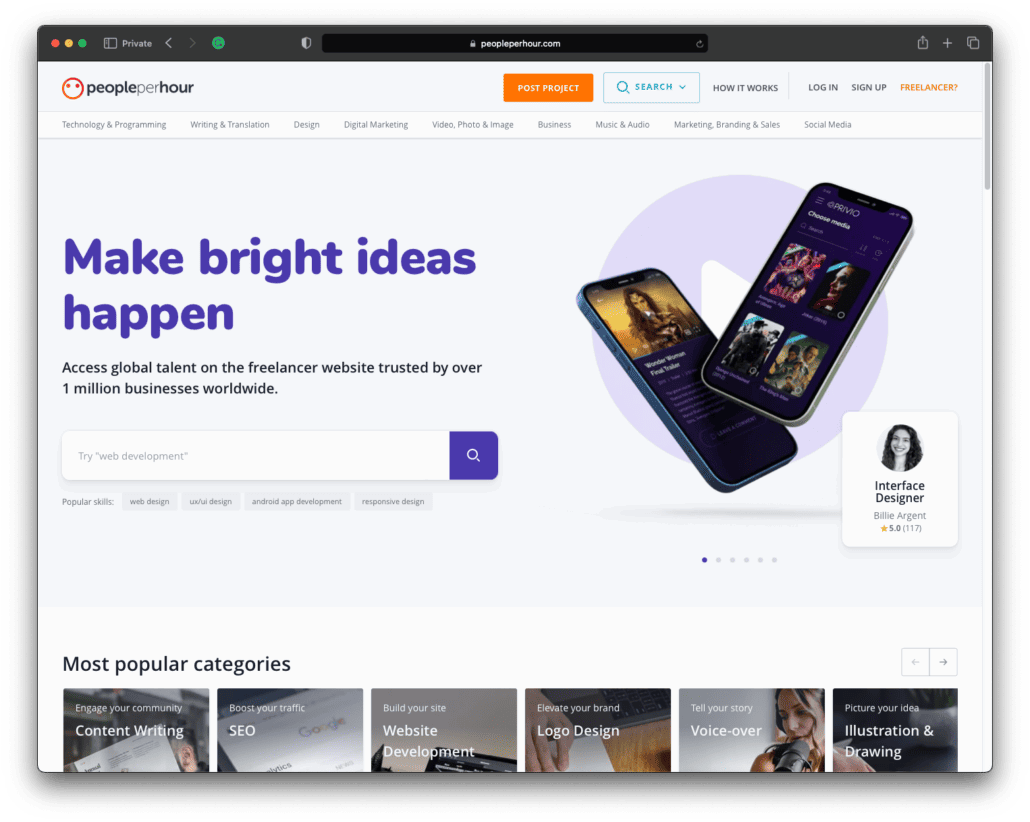
PeoplePerHour focuses on creative, marketing, and technical freelancers, with a strong presence in the UK and Europe. The platform uses an AI‑powered matching engine to suggest suitable freelancers for posted projects.
- Pricing: Freelancer service fee of 10–20% depending on project value and membership. Client service fee of 5% (or £2 minimum).
- Key advantage: Strong UK/EU focus, AI‑powered matching, and escrow protection.
- Best for: UK/EU-focused creative, content, and marketing work.
- Not ideal for: companies that want the broadest possible talent pool across all categories.
- Watch-outs: Freelancer fees can be higher at the low end of a new buyer relationship, so smaller projects may feel more expensive until repeat engagements develop.
Why it stands out: PeoplePerHour is especially useful when regional fit matters. Its reputation is strongest in the UK and Europe, making it more attractive for buyers who want overlapping time zones, local market familiarity, or easier collaboration with creatives and marketers serving those audiences.
When analyzing Upwork vs. PeoplePerHour, the biggest distinction is not global scale but regional relevance and creative-market orientation.
7. Contra – Best for Zero‑Commission Freelancing
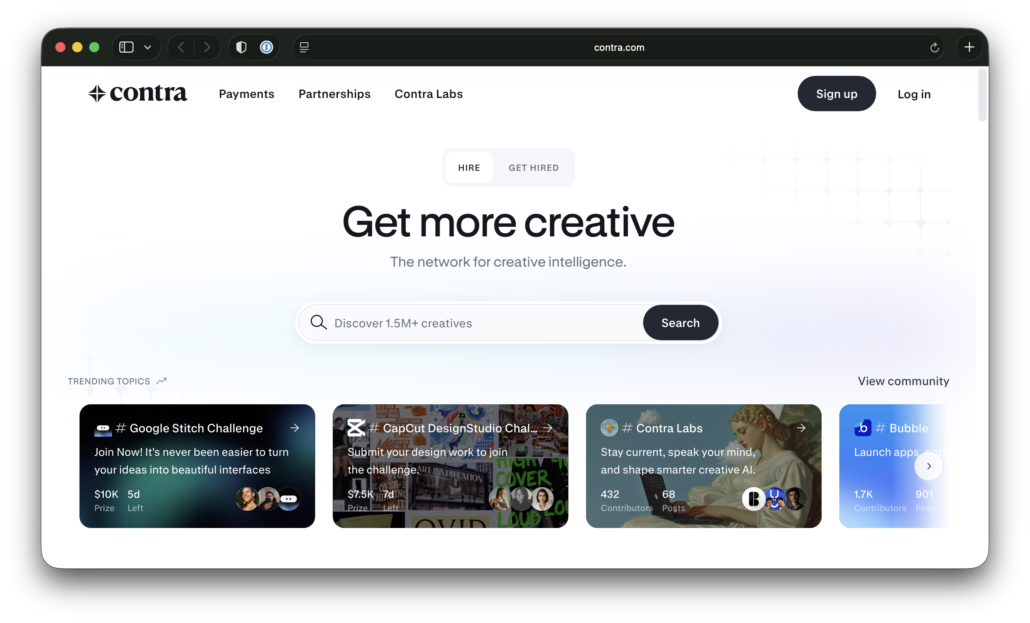
Contra operates on a commission‑free model for freelancers. Freelancers keep 100% of their earnings, and Contra offers a “Commission‑Free” mode for portfolio‑first projects.
- Pricing: Freelancers set their rates and keep all earnings. No bidding wars. Contra’s Trustpilot rating (4.5/5 as of March 2026) confirms strong user satisfaction.
- Key advantage: No bidding, portfolio‑first approach, and a modern client base that includes many startup founders.
- Best for: Designers, developers, marketers, and independent creators who want to keep more of their earnings by avoiding commission costs and bidding systems and to showcase a polished professional profile.
- Not ideal for: Users who expect the raw volume of jobs found on very large marketplaces.
- Watch-outs: Even when a platform markets itself as commission-free, buyers and freelancers should still check payment-processing or plan-related costs and consider whether the available client pool matches their niche.
Why it stands out: Contra appeals strongly to modern freelancers and startup-friendly buyers because it removes the traditional commission-heavy marketplace model.
Its portfolio-first approach makes it feel different from bid-based platforms. This is valuable for freelancers who want to be discovered through brand, work samples, and positioning rather than by joining a race to the bottom on price.
For many users, Contra is less about volume and more about quality of presentation and direct relationship-building.
8. FlexJobs – Best for Remote Professional Freelancers
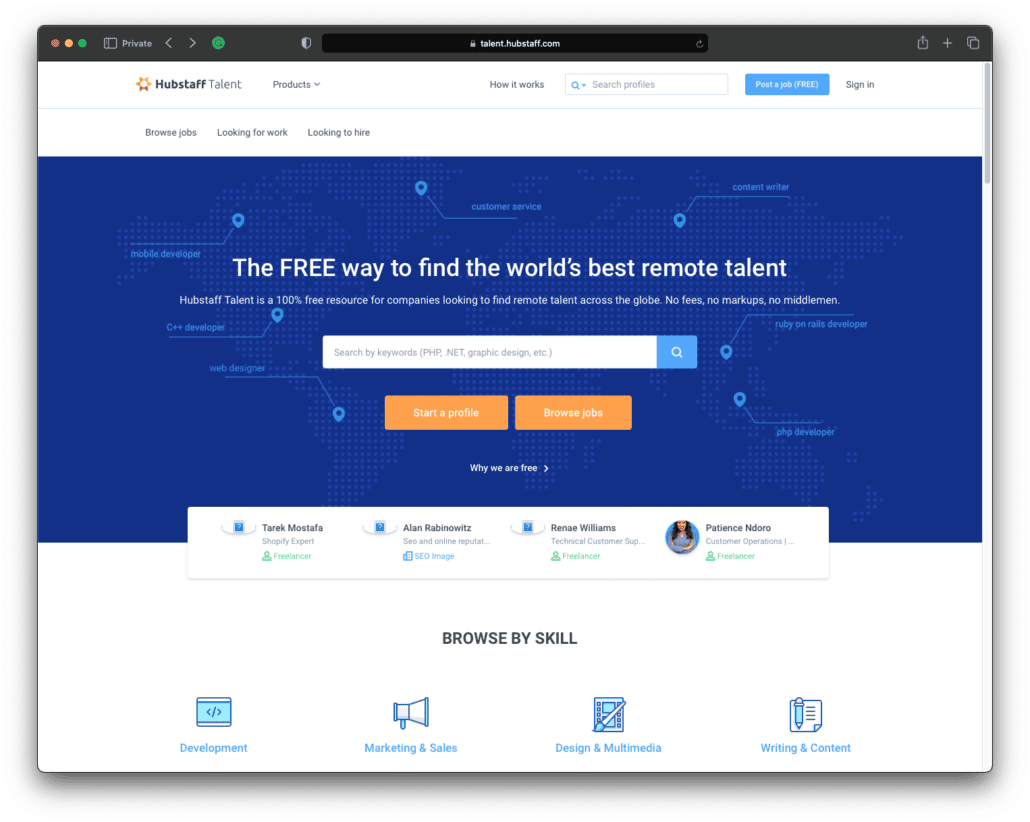
FlexJobs curates and verifies every listing, significantly reducing the risk of scams. It focuses on remote and flexible work across professional categories like marketing, writing, and customer support. FlexJobs holds an A+ rating from the Better Business Bureau.
- Pricing: Freelancer membership plans starting at $9.95/week or $49.95/month. Clients pay for job postings (starting at $299.95 per job).
- Key advantage: Hand‑screened listings, no scams, and a focus on legitimate remote and freelance positions.
- Best for: Freelancers seeking scam-free remote jobs and businesses wanting to reach screened applicants.
- Not ideal for: Freelancers or clients who want a high-volume bidding marketplace, instant proposal-based hiring, or very low upfront costs.
- Watch-outs: FlexJobs is more of a curated remote job board than a traditional freelance marketplace, so opportunities may move more slowly; the freelancer subscription can be a barrier for budget-conscious users, and employers may find job posting costs higher than open marketplaces.
Why it stands out: FlexJobs is different from most entries on this list because it behaves more like a vetted remote job board than a bidding marketplace.
This makes it appealing for freelancers and remote professionals who prioritize legitimacy and reduced scam exposure over high-volume direct bidding. It is also useful for employers that want access to applicants in a credibility-focused environment rather than a marketplace optimized for proposal competition.
Head‑to‑Head Comparison Table
| Platform | Best For | Pricing Model | Freelancer Fee | Client Fee | Key Strength |
| MyOutDesk | Dedicated VAs | Monthly plans | Custom | Custom | Fully managed, vetted assistants |
| Toptal | Elite freelancers | Hourly ($60–$200+) | 0% | 0% | Top 3% talent, no-risk trial |
| Fiverr | Gig-based projects | Per gig | 20% of gig | 5.5%/5% | Fast, pre- packaged gigs |
| Freelancer.com | Competitive bidding | Bidding | 10% | 3% | Massive global talent pool |
| Guru | Structured collaboration | Freelancer membership tiers | 5–0% | 2.9% | Low fees, transparent workroom |
| PeoplePerHour | UK/EU creative talent | Hourly/project | 10–20% | 5% (or £2 min) | AI matching, escrow protection |
| Contra | Zero-commission freelancing | Freelancer set rates | 0% (Commission- Free mode) | 0% | No bidding, portfolio-first |
| FlexJobs | Remote professional | Freelancer subscription | $49.95/week+ | $299.95/job posting | Hand- screened, scam-free listings |
Which Upwork Alternative Is Right for You?
The shortest answer is this: choose the platform that reduces your biggest source of risk.
If your main problem with Upwork is the time it takes to screen, test, and manage talent, a managed option like MyOutDesk may create the best outcome.
If your risk is poor execution on a technical or strategic project, Toptal’s premium screening can be worth the added cost.
If your risk is simply overpaying for a simple task, Fiverr or Freelancer.com may offer enough flexibility and price competition to get the job done faster.
If your goal is broad market access and competitive bids, Freelancer.com remains useful, especially for buyers comfortable evaluating multiple proposals.
If you want a lower-fee, more structured environment for continuing freelancer relationships, Guru is a practical middle-ground choice.
If your focus is the UK or Europe, PeoplePerHour may produce better regional matches for creative and marketing work than a larger but less regionally concentrated platform.
For businesses hiring virtual assistants or operations support, MyOutDesk is the clearest fit because the model is built around consistency, accountability, and longer-term support.
For startup teams, SaaS companies, and product organizations hiring senior specialists, Toptal is better aligned with high-impact work where expertise matters more than bargain pricing.
For marketers, founders, and creators who need quick design or content deliverables, Fiverr works well when the scope is narrow and the expected output is easy to define upfront.
For freelancers, the decision framework is different. Contra is attractive when protecting margin and showcasing a portfolio-first identity matter most. FlexJobs is appealing when safety, legitimacy, and curated remote opportunities matter more than bidding volume.
In other words, there is no universal winner. The best Upwork alternative depends on whether your priority is vetted quality, lower fees, easier sourcing, regional fit, or scam resistance.
Frequently Asked Questions (FAQs)
Is there a free alternative to Upwork?
Yes—if by “free” you mean there is no traditional freelancer commission, Contra is one of the strongest options because it promotes a commission-free model for creatives. Guru also has a free membership tier, and several platforms allow you to create an account without paying upfront.
The more important question, however, is whether the platform has indirect costs such as subscriptions, processing fees, buyer fees that affect budgets, or heavier self-management requirements. A platform can look free at sign-up but still be expensive in time or total transaction cost.
Which platform has the lowest fees?
For freelancers, Contra is often cited as the lowest-fee option because of its commission-free positioning, while Guru can be relatively low-cost depending on membership tier.
For clients, Toptal avoids a visible client platform fee in the conventional marketplace sense, and Freelancer.com or Guru can be competitive on the buyer side.
Still, the smartest comparison is not the headline percentage alone. A lower platform fee can be offset by weaker vetting, more proposal screening, higher churn risk, or more time spent managing the relationship.
Which platform is best for long‑term projects?
MyOutDesk, Toptal, and Guru are among the strongest options for long-term projects, but for different reasons.
MyOutDesk is built for dedicated assistant relationships and ongoing operational support. Toptal works well for senior specialists embedded in longer technical or strategic engagements. Guru supports milestone-based and recurring work in a more structured way than many gig-first platforms.
If your goal is to build continuity, avoid platforms that are optimized mainly for one-off transactions unless you already have a repeatable hiring process in place.
What is the cheapest Upwork alternative for businesses?
For businesses focused strictly on platform fees, Contra and Guru are often among the lowest-cost options, with Freelancer.com also remaining competitive for many projects.
But the cheapest option is not always the most economical overall. If a lower-cost marketplace increases the hours spent screening, revising, replacing talent, or recovering from missed deadlines, the effective cost can exceed a more curated alternative. Businesses should compare total hiring cost, not just the fee schedule.
How do I avoid Upwork’s Connects costs?
The simplest way to avoid Upwork’s Connects costs is to use a platform that does not rely on a pay-to-propose system.
Contra, Toptal, Guru, and FlexJobs all reduce or remove that specific bidding expense in different ways.
For freelancers, this can improve margins and lower the cost of customer acquisition. It can also shift the strategy from submitting many proposals to building a stronger profile, portfolio, or direct-fit positioning.
Which alternative has the best customer support?
Among the platforms in this list, MyOutDesk and Toptal generally stand out most for hands-on support because both are more service-oriented than purely self-serve marketplaces.
MyOutDesk emphasizes client success and ongoing relationship management, while Toptal provides matching support and a more guided experience.
On open platforms such as Fiverr, Freelancer.com, Guru, and PeoplePerHour, support quality can vary more because the model is built around marketplace transactions at scale.
The Bottom Line: Which Upwork Alternative Should You Choose?
The freelance economy is evolving rapidly, and the way people discover, compare, and choose platforms is evolving with it.
Businesses no longer evaluate freelance marketplaces only by how many users they have. They now care about pricing clarity, reliability, speed to hire, niche specialization, and how much management time a platform quietly demands after the contract starts.
Freelancers are making similar calculations from the other side: not just where the most jobs exist, but where the fee structure, client quality, and long-term earning potential make the most sense.
Evaluate the trade‑offs carefully: lower fees may come with less vetting or higher management overhead. Premium platforms offer reliability and quality but at a higher price point.
About The Author

Jeanette C. Patindol is a content writer specializing in virtual assistants, business process outsourcing, remote workforce management, and B2B digital marketing. Drawing on over 20 years as a university professor of Business Economics and Communications and extensive consultancy experience, she brings rigorous research and exceptional writing quality to every piece she creates for MyOutDesk.
Related Posts
-
 Hiring, Virtual Assistants
How Much Does an HR Virtual Assistant Cost in 2026? (Complete Pricing Guide for Small Businesses)
Outsourcing HR can save a small business 40–70% compared to hiring a full-time in-house HR manager, whose average total compensation exceeds $153,875/year (salary plus benefits and overhead).
Read more -
 Hiring
25 Virtual Assistant Statistics To Help Scale Your Business Faster In 2026
Discover the most important virtual assistant statistics for 2026, from cost savings and productivity gains to how modern businesses are scaling with remote talent.
Read more -
 Hiring
How To Hire a Virtual Assistant: The Complete 2026 Guide
Unlocking the benefits of hiring a virtual assistant can transform your business. From cutting costs to boosting productivity and enhancing flexibility, a skilled virtual assistant is a game-changer for achieving your goals. Ready to make the leap? If you’ve decided that a virtual assistant is the right solution to elevate your business, it’s time to focus on making your first hire a resounding success. The key? Hiring the right virtual assistant for your needs.
Read more -
 Hiring
Blended Business Model: Integrating Remote Workers, Virtual Assistants & In-Office Staff
The modern workforce is blended—uniting in-office staff, remote employees, and virtual assistants into one high-performing team. Learn why more companies are adopting this model, common pitfalls to avoid, and how to implement it successfully.
Read more -
 Hiring
The 6 Best Real Estate Virtual Assistant Companies – 2026 Update
Enhance your business with insights highlighting the best real estate virtual assistant companies. Discover tailored solutions to streamline operations, optimize client interactions, and drive success in the competitive real estate market.
Read more -
 Hiring, Virtual Assistants
Top Tools for Measuring Employee Satisfaction in 2026
These are the most effective employee satisfaction measurement tools that help organizations understand how their teams feel and identify areas for improvement.
Read more -
 Hiring
8 Best Virtual Assistant Companies of 2026
Explore the best virtual assistant companies expertly curated by MyOutDesk. We’ll help you find top virtual assistance solutions that cater to your business needs, enhancing productivity, fostering scalability and streamlining operations.
Read more -
 Healthcare, Hiring, Virtual Assistants
Executive Insights: Solving The Healthcare Talent Shortage with Virtual Teams
The healthcare industry in the United States is grappling with a severe talent shortage that threatens the quality and accessibility of patient care. According to the Association of American Medical Colleges (AAMC), the US could face a deficit of approximately 139,000 doctors by 2033. Additionally, the US Department of Health and Human Services reports that … Read more
Read more -
 Hiring
Outsourcing To The Philippines: Pros, Cons & More
The Philippines is one of the top destinations where major corporations outsource their business needs too, allowing businesses to keep overhead down on expenses such as office space, equipment, internet connection, taxes, and even benefits.
Read more -
 Hiring
The 5 Best Virtual Receptionist Services of 2026
Discover 5 leading virtual receptionist service options in MyOutDesk’s comprehensive guide. Explore how these services can revolutionize your business communication, providing efficiency and professionalism for unparalleled customer interactions.
Read more -
 Hiring
Fiverr vs. Upwork: Comparing Workflow, Cost, and Freelance Talent For Your Business
Unsure about Fiverr vs. Upwork? MyOutDesk’s blog delves into the comparison, offering insights to help you choose the right freelance platform for your projects. Make informed decisions and maximize your freelancing opportunities with this comprehensive guide.
Read more -
 Hiring
What Is a Hybrid Business? Definition, Benefits, Examples, and More
By blending in-house teams with outsourced virtual assistants, businesses are optimizing productivity and cost-effectiveness. Common among US corporations, this approach bolsters operational efficiency, cost reduction, and business growth. With perks such as improved flexibility, cost savings, and amplified efficiency, firms like MyOutDesk offer specialized virtual assistant services to help businesses maximize these benefits.
Read more